

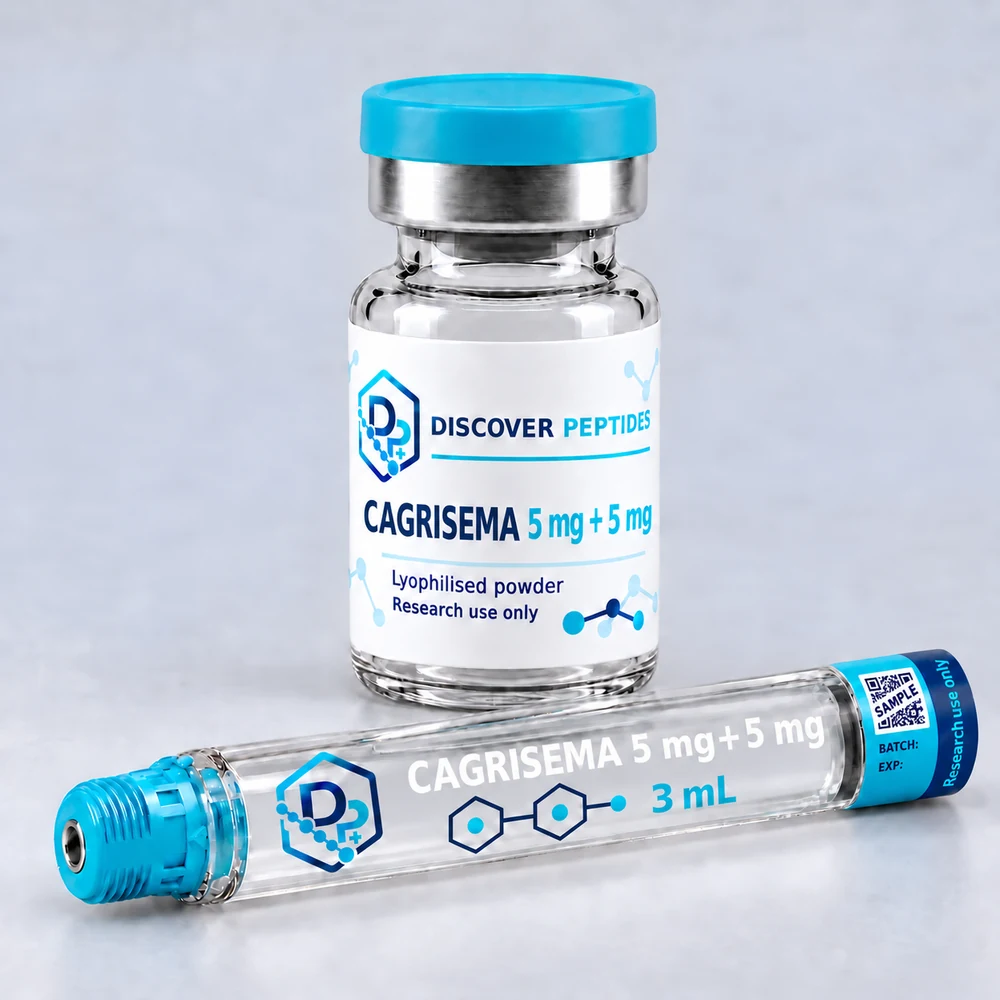
CagriSema 5 mg + 5 mg
R3,922.00
An evidence-based, plain-language research page explaining the amylin analogue cagrilintide, its combination with semaglutide, current evidence, safety and regulatory status.
Please note, to maintain the quality and integrity of every product, all orders are fulfilled on a made-to-order basis. Please allow 7–14 days for processing and delivery. You will receive tracking details as soon as your order is dispatched.
Research Use Only.
This product is supplied strictly for research use. It is not intended for human consumption, administration, therapeutic use, diagnosis, or veterinary use. Customers are responsible for ensuring that their purchase and use of research products comply with applicable laws, regulations, and institutional requirements.
- Research Focused
- Clear Specifications
- Transparent Pricing
- South African Supply
POPULAR 2026 | RESEARCH LIBRARY
Cagrilintide & CagriSema
An evidence-based, plain-language research page explaining the amylin analogue cagrilintide, its combination with semaglutide, current evidence, safety and regulatory status.
Contents
What cagrilintide and CagriSema are
Important information and disclaimer
Researched for
Potential future uses
How they work
What research has found
Latest 2026 evidence
How they compare
Current status
Risks and uncertainties
Dosing and measurement uncertainty
Common questions
Join for updates
Sources
Important information and disclaimer
This page is for general education and discussion of published research. It does not advertise, offer, prescribe or recommend cagrilintide, CagriSema or semaglutide. It does not replace advice from a qualified healthcare professional and does not provide personal dosing, reconstitution or injection instructions.
Cagrilintide is an investigational long-acting amylin analogue. CagriSema is the development name for a fixed-dose combination of cagrilintide and semaglutide. An online vial labelled 'cagrilintide', 'Cagri' or 'CagriSema' is not thereby proven to contain either authentic component, the correct proportions, pharmaceutical-grade material or a sterile finished medicine.
If someone has used an unknown product and becomes unwell, professional medical assistance is appropriate. Persistent vomiting, inability to keep fluids down, severe abdominal pain, confusion, collapse, breathing difficulty, severe weakness, or suspected low blood glucose requires urgent assessment. People using insulin or sulfonylureas need particular clinical supervision because glucose-lowering combinations can increase hypoglycaemia risk.
What are cagrilintide and CagriSema?
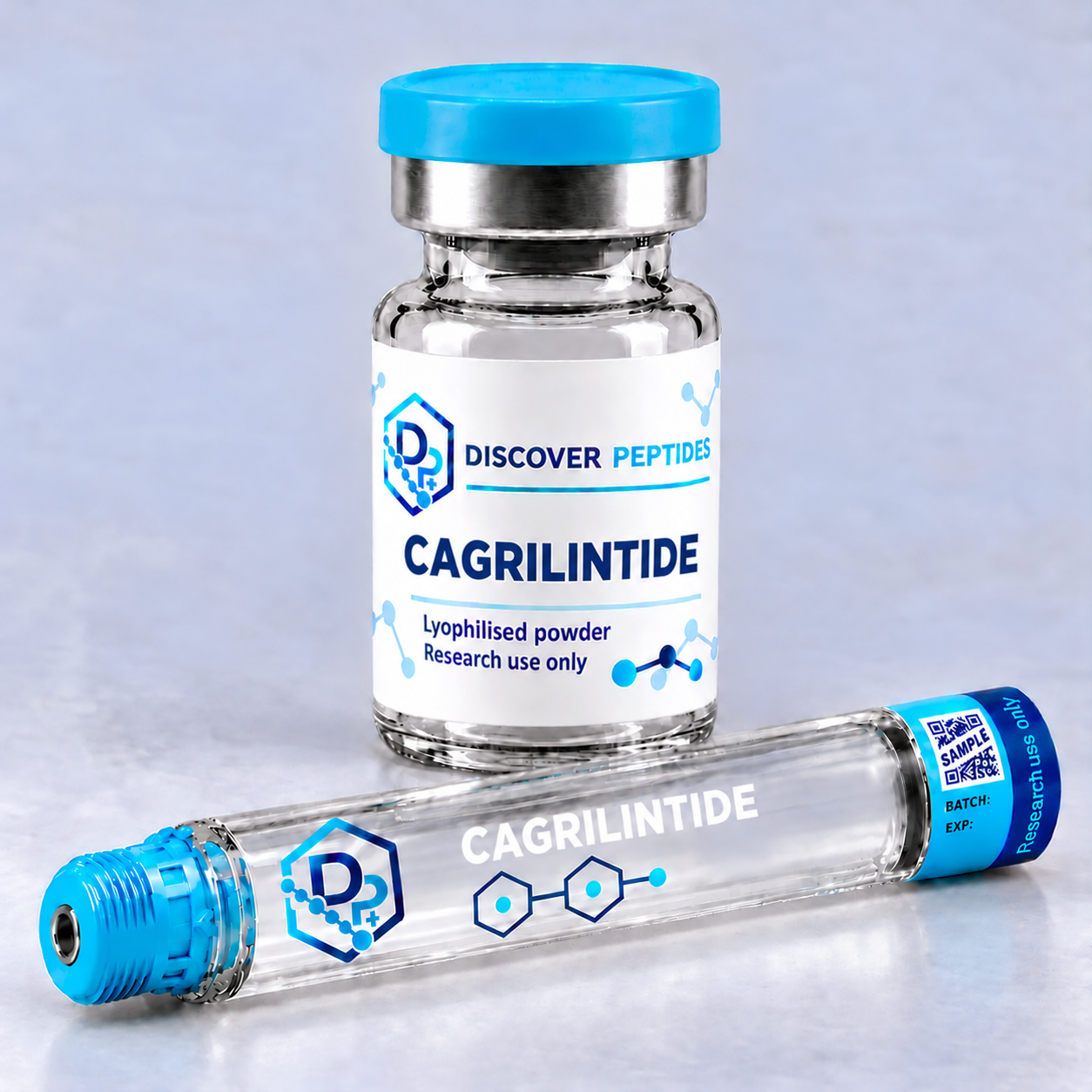
Cagrilintide is a laboratory-designed, long-acting analogue of amylin, a hormone normally co-secreted with insulin by pancreatic beta cells. It was designed to activate amylin receptors for longer than natural amylin and is being developed by Novo Nordisk for weight management and related metabolic conditions.
CagriSema is not a separate peptide and does not have one single peptide identity. It is a fixed-dose combination containing two active ingredients: cagrilintide and semaglutide. Semaglutide is a GLP-1 receptor agonist used in authorised medicines in many countries, while cagrilintide remains investigational.
Identity and naming
What are they being researched for?
The main research question is whether amylin-receptor activity can support clinically meaningful and sustainable weight reduction, and whether combining it with GLP-1 receptor activity provides complementary benefit with acceptable tolerability.
Obesity and overweight • Weight management in type 2 diabetes • Glycaemic control • Treatment alongside basal insulin • Direct comparison with tirzepatide • Maintenance and longer-term cardiometabolic outcomes
These are research programmes, not a general permission for use. A reduction in body weight or HbA1c does not automatically prove fewer heart attacks, less kidney failure, improved survival or long-term maintenance after discontinuation.
Other potential uses—if future research confirms them
Future research may clarify whether cagrilintide alone or CagriSema improves obesity-related complications, body composition, mobility, sleep-disordered breathing, liver fat, cardiovascular risk markers or insulin requirements. These possibilities remain condition- and trial-specific.
The presence of semaglutide in CagriSema also creates an interpretation problem: an observed effect cannot automatically be attributed to cagrilintide. Active-controlled and component trials are needed to separate the contribution of each ingredient.
How might cagrilintide and CagriSema work?
Amylin-receptor activity
Natural amylin participates in meal-related signalling, satiety, gastric emptying and post-meal glucose regulation. Cagrilintide is designed to prolong this signalling. In simple terms, researchers are testing whether it can help people feel satisfied with less food and reduce energy intake over time.
GLP-1 receptor activity
Semaglutide can increase glucose-dependent insulin secretion, reduce glucagon when glucose is elevated, slow gastric emptying and affect appetite pathways. Its established pharmacology does not make every semaglutide-containing combination automatically equivalent to an authorised semaglutide medicine.
Why combine them?
CagriSema combines two distinct hormonal pathways. The scientific hypothesis is that amylin and GLP-1 signalling may provide complementary effects on appetite, food intake and glucose regulation. The final effect depends on the formulation, component ratio, escalation schedule, adherence and individual biology; it cannot be predicted by simply adding two headline percentages.
What has research found so far?
REDEFINE 1: adults without diabetes
In the 68-week Phase 3a REDEFINE 1 trial, 3,417 adults with overweight or obesity were assigned to CagriSema, semaglutide, cagrilintide or placebo alongside lifestyle intervention. Under the treatment-policy analysis, mean weight change was reported as -20.4% with CagriSema and -3.0% with placebo. The study also provided active-component comparisons, which are important for understanding the combination.
REDEFINE 2: adults with type 2 diabetes
In the 68-week Phase 3a REDEFINE 2 trial, 1,206 adults with overweight or obesity and type 2 diabetes were randomised to CagriSema or placebo. Mean weight change under the treatment-policy analysis was reported as -13.7% with CagriSema and -3.4% with placebo. Gastrointestinal events were the most common adverse-event category and were generally transient and mild to moderate.
REDEFINE 4: direct comparison with tirzepatide
In 2026, the REDEFINE 4 head-to-head programme became strategically important because it compared CagriSema with tirzepatide rather than placebo. Publicly reported results indicated that CagriSema did not meet the prespecified non-inferiority objective for weight reduction. This does not mean that it had no effect; it means the trial did not establish the required statistical comparison against tirzepatide.
REIMAGINE 3: use with basal insulin
A 2026 Phase 3 study in adults with type 2 diabetes inadequately controlled on basal insulin reported greater HbA1c and body-weight reductions with CagriSema than placebo and lower daily basal-insulin requirements. This was a monitored study with protocol-controlled dose adjustment; it should not be translated into self-management instructions for insulin users.
Latest 2026 evidence update
Cross-trial percentages should not be treated as a league table. Trial populations, diabetes status, durations, estimands, discontinuation handling, lifestyle support and comparator drugs differ.
How cagrilintide and CagriSema compare with related medicines
Cagrilintide should not be described as 'generic CagriSema'. CagriSema should not be described as 'semaglutide plus anything', because the identity, ratio, formulation and regulatory dossier matter. Neither name should be used as a synonym for tirzepatide or retatrutide.
Current development and regulatory status
Status on 7 September 2026: cagrilintide alone remains investigational. Its Phase 3 RENEW programme is studying weight management with and without type 2 diabetes. CagriSema has completed several Phase 3 studies and Novo Nordisk has publicly reported filing a US application for weight management; filing does not equal approval.
This page found no basis to present cagrilintide or CagriSema as a SAHPRA-registered finished medicine. South African regulatory databases and official communications should be checked again immediately before publication and whenever a major regulatory decision occurs.
The May 2026 SAHPRA/SAPC communication about unlawful manufacture and distribution of unregistered GLP-1/GIP products is relevant to online-market conduct, but it does not prohibit neutral educational discussion. The distinction is between publishing accurate research information and advertising, supplying or making therapeutic claims for an unregistered medicine.
Known risks, uncertainties and evidence gaps
The most frequently reported adverse events in CagriSema studies have been gastrointestinal, including nausea, diarrhoea, vomiting and constipation. Reduced appetite can also contribute to dehydration or inadequate nutritional intake. Tolerability may depend on escalation, dose achieved, concomitant medicines and individual susceptibility.
Hypoglycaemia risk requires special attention when glucose-lowering therapy is combined with insulin or a sulfonylurea.
Persistent gastrointestinal symptoms can contribute to dehydration and kidney stress.
Gallbladder disease, pancreatitis signals, heart-rate changes and severe gastrointestinal disease require ongoing class- and product-specific evaluation.
Pregnancy, breastfeeding, childhood use, frailty, eating disorders and severe liver, kidney or gastrointestinal disease are not situations for extrapolation from general trial averages.
Long-term maintenance, body composition, muscle preservation and outcomes after discontinuation remain important evidence questions.
Clinical-trial safety data apply to screened participants using controlled investigational or authorised materials. They cannot predict risks from an unidentified online vial, where substitution, incorrect strength, non-sterility, impurities or degradation may create additional hazards.
Dosing: why this page does not provide instructions
This educational page does not provide a cagrilintide or CagriSema dose, titration schedule, reconstitution volume, mixing ratio or syringe-unit conversion. Clinical-trial schedules were protocols for screened participants using controlled formulations and monitoring.
CagriSema is particularly vulnerable to naming and measurement errors because it contains two active ingredients. A vial labelled with one total milligram value may not disclose how much belongs to each component. Adding semaglutide and cagrilintide from separate unverified vials does not recreate the studied fixed-dose product.
Terms such as milligrams, millilitres and syringe 'units' are not interchangeable. A syringe mark indicates volume, not peptide mass. Without verified identity and concentration, a conversion calculation can be mathematically neat and clinically meaningless.
Common questions
Is CagriSema one peptide?
No. It is a fixed-dose combination of cagrilintide and semaglutide.
Is cagrilintide the same as CagriSema?
No. Cagrilintide is one component. CagriSema contains cagrilintide plus semaglutide.
Is CagriSema approved because an FDA application was filed?
No. Filing begins regulatory review. Approval requires a regulator to accept the evidence, manufacturing controls, benefit-risk balance and proposed labelling.
Did REDEFINE 4 prove CagriSema does not work?
No. The publicly reported issue was failure to meet a prespecified non-inferiority comparison with tirzepatide. That is different from showing no weight-loss effect.
Does 'research grade' mean pharmaceutical grade?
No. The phrase does not prove identity, purity, potency, sterility, stability, formulation quality or suitability for human administration.
Can separate cagrilintide and semaglutide vials be mixed to make CagriSema?
They should not be represented as the studied fixed combination. Formulation compatibility, verified identity, concentration, sterility, stability and component ratios cannot be assumed.
When will it be available in South Africa?
There is no confirmed South African availability date. US filing, possible FDA review and any later SAHPRA process are separate events.
Join for research updates
Join the future research bulletin for major trial publications, regulatory decisions, safety communications, terminology corrections and South African status changes. Subscription does not provide personal dosing advice, product access or early access to an investigational medicine.
Consent wording for the future form: “I agree to receive evidence and regulatory updates by email. This service does not provide medical advice, personal dosing instructions or product supply.”
Sources and further reading
Garvey WT, et al. Coadministered Cagrilintide and Semaglutide in Adults with Overweight or Obesity. New England Journal of Medicine, 2025;393:635-647.
Davies MJ, et al. Cagrilintide-Semaglutide in Adults with Overweight or Obesity and Type 2 Diabetes. New England Journal of Medicine, 2025;393:648-659.
ClinicalTrials.gov. NCT05567796: REDEFINE 1. Registry record reviewed 7 September 2026.
ClinicalTrials.gov. NCT06131437: REDEFINE 4, CagriSema compared with tirzepatide. Registry record reviewed 7 September 2026.
ClinicalTrials.gov. NCT06323161: REIMAGINE 3. Registry record reviewed 7 September 2026.
ClinicalTrials.gov. NCT07220642: RENEW 1 cagrilintide Phase 3 study. Registry record reviewed 7 September 2026.
ClinicalTrials.gov. NCT07220759: RENEW 2 cagrilintide Phase 3 study. Registry record reviewed 7 September 2026.
Rosenstock J, et al. Cagrilintide-semaglutide as add-on to basal insulin in adults with type 2 diabetes (REIMAGINE 3). The Lancet, 2026. DOI: 10.1016/S0140-6736(26)01022-6.
Novo Nordisk. REDEFINE 1 and REDEFINE 2 study summaries and 2026 CagriSema regulatory communications. Accessed 7 September 2026.
U.S. FDA Global Substance Registration System. Cagrilintide substance record. Accessed 7 September 2026.
SAHPRA and South African Pharmacy Council. Communication concerning unlawful manufacture and distribution of unregistered GLP-1/GIP medicines, May 2026.
Editorial method: primary trial registries, peer-reviewed reports, regulators and sponsor disclosures were prioritised over commercial pages. Status statements are dated because clinical development and regulatory positions can change. This page separates established findings, sponsor-reported results and reasonable research questions.
Lyophilized: Stable at −20°C for up to 24 months when kept dry and protected from light.
Reconstituted: Store at 2–8°C. Use within 28 days. Do not freeze after reconstitution.
Diluent: Bacteriostatic water (BW) recommended for multi-dose use. See Protocols.
Research Use Only.
This product is supplied strictly for research use. It is not intended for human consumption, administration, therapeutic use, diagnosis, or veterinary use. Customers are responsible for ensuring that their purchase and use of research products comply with applicable laws, regulations, and institutional requirements.
You may also research
Related Compounds
Reviews
There are no reviews yet.