
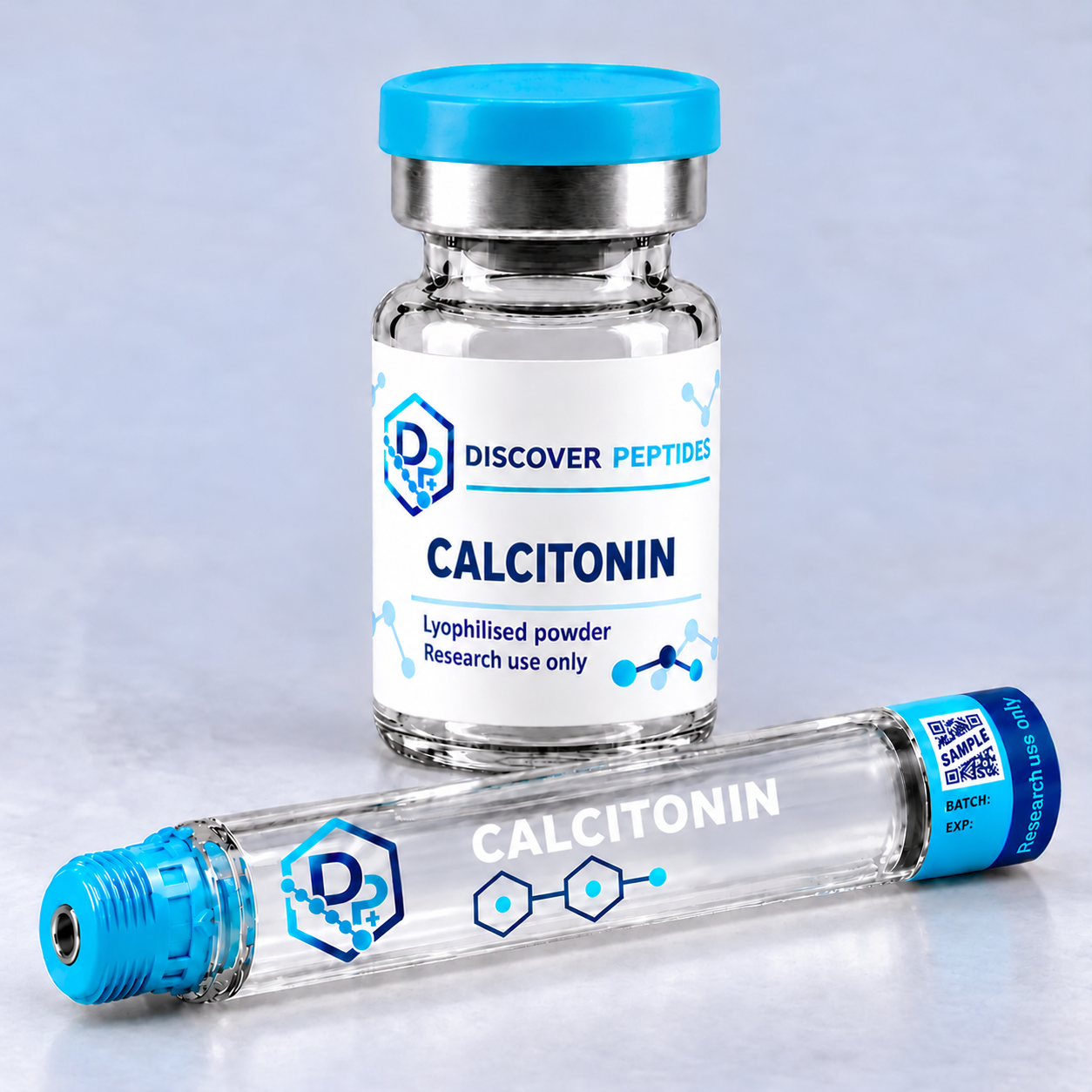
Calcitonin
R750.00
An evidence-based, plain-language information page on human and salmon calcitonin, nasal and injectable products, modern treatment roles, malignancy concerns and South African context.
Please note, to maintain the quality and integrity of every product, all orders are fulfilled on a made-to-order basis. Please allow 7–14 days for processing and delivery. You will receive tracking details as soon as your order is dispatched.
Research Use Only.
This product is supplied strictly for research use. It is not intended for human consumption, administration, therapeutic use, diagnosis, or veterinary use. Customers are responsible for ensuring that their purchase and use of research products comply with applicable laws, regulations, and institutional requirements.
- Research Focused
- Clear Specifications
- Transparent Pricing
- South African Supply
POPULAR 2026 | RESEARCH LIBRARY
Calcitonin
An evidence-based, plain-language information page on human and salmon calcitonin, nasal and injectable products, modern treatment roles, malignancy concerns and South African context.
Contents
What calcitonin is
Important information and disclaimer
Approved and researched uses
Potential future uses
How it works
What evidence has found
Current regulatory and South African status
How it compares
Risks and uncertainties
Treatment and product safeguards
Common questions
Join for updates
Sources
Important information and disclaimer
This page is for general education. Calcitonin products are prescription medicines whose authorised uses differ by molecule, formulation, route and country. Calcitonin is no longer a routine first-choice osteoporosis medicine in many settings, and long-term use has been restricted because of limited fracture evidence and a possible increase in malignancy risk. This page does not diagnose a bone or calcium disorder, recommend treatment, or replace registered product information.
A spray, ampoule, vial or powder labelled ‘calcitonin’, ‘salmon calcitonin’, ‘Miacalcin’, ‘Miacalcic’ or ‘research grade’ is not thereby an authorised medicine. Identity, species sequence, peptide content, biological potency, sterility, excipients, delivery accuracy, stability and storage may be unknown. International units cannot safely be converted from mass without the product’s validated potency standard.
Breathing difficulty, swelling of the tongue or throat, collapse, severe rash, seizure, marked muscle cramps or twitching, confusion, or symptoms of severely abnormal calcium require urgent care. Hypercalcaemia can itself be an emergency and requires investigation of the cause, fluids and other condition-specific treatment—not unsupervised calcitonin use.
What is calcitonin?
Calcitonin is a 32-amino-acid peptide hormone. Human calcitonin is produced mainly by thyroid parafollicular C cells and helps regulate calcium and bone turnover. Medicinal products have most often used synthetic or recombinant salmon calcitonin, which has a different sequence and greater biological potency at the human calcitonin receptor than human calcitonin.
Names and products that must not be confused
What is calcitonin approved or researched for?
Paget’s disease of bone
Current US injectable calcitonin salmon labelling reserves it for symptomatic Paget’s disease when alternative treatments are unsuitable. Modern bisphosphonates generally produce stronger and more durable biochemical control. Calcitonin may still have a limited role when standard options cannot be used, with response assessed clinically and by appropriate bone-turnover markers.
Hypercalcaemia
Injectable calcitonin can lower calcium relatively quickly and may be used early in a hypercalcaemic emergency while slower, longer-acting measures address the underlying cause. Its effect often weakens after a short period because receptors become less responsive. It is therefore an adjunct or bridge in monitored care, not a complete or durable solution.
Postmenopausal osteoporosis
US labels still describe selected nasal or injectable calcitonin salmon use in women more than five years after menopause when alternatives are unsuitable. The injectable label states that fracture-reduction efficacy has not been demonstrated. Nasal evidence suggested a vertebral-fracture signal at one studied dose, but inconsistent dose-response, modest bone-density effects and malignancy concerns reduced confidence and use.
Other potential uses – only if future research confirms them
Calcitonin has been studied for acute pain after vertebral compression fracture, other painful bone disorders, osteoarthritis and bone loss after immobilisation. Some short-term analgesic findings have been reported, but products and guidelines differ and this is not a universal indication. An observed reduction in pain does not prove fracture healing or justify long-term treatment.
Future research may better define short-duration, high-benefit niches; biomarkers of response; receptor desensitisation; and safer calcitonin-receptor pathway drugs. Any new analogue must establish its own sequence, potency, clinical benefit and long-term safety rather than relying on historical salmon-calcitonin evidence.
How does calcitonin work?
Osteoclast inhibition
Calcitonin binds the calcitonin receptor on osteoclasts, the cells that resorb bone. It rapidly reduces osteoclast activity and movement, lowering release of calcium from bone. The kidney can also excrete more calcium, phosphate and sodium. These actions explain both the calcium-lowering effect and the risk of hypocalcaemia.
Why salmon calcitonin is used
Salmon calcitonin differs substantially from the human sequence but binds the human receptor strongly and has a longer pharmacological effect. That advantage also makes exact identity and potency important. Results for salmon calcitonin cannot automatically be transferred to human calcitonin or an uncharacterised analogue.
Loss of effect over time
The calcium-lowering response often diminishes within days, a phenomenon commonly called tachyphylaxis. Receptor down-regulation and other adaptive mechanisms contribute. With longer exposure, anti-calcitonin antibodies can also appear and may reduce response in some patients.
What has evidence found?
Bone density and fractures
Calcitonin produces modest antiresorptive effects, but its osteoporosis evidence is weaker than that of modern bisphosphonates, denosumab and bone-forming medicines. The current US injectable label explicitly notes that fracture-reduction efficacy has not been demonstrated. A bone-density change is a surrogate and should not be presented as proof of fewer hip or other clinically important fractures.
The malignancy signal
A US label meta-analysis of 21 randomised trials reported overall malignancies in 4.1% of calcitonin-salmon recipients versus 2.9% with placebo. A definite causal mechanism was not established, and the estimate was influenced by individual trials, but the imbalance could not be dismissed. The European Medicines Agency responded by recommending that calcitonin be used only for short-term indications at the minimum effective exposure and that intranasal calcitonin no longer be used for osteoporosis in Europe.
A narrow modern role
Calcitonin remains pharmacologically useful because it can act quickly in severe hypercalcaemia and may be an option in selected patients who cannot use alternatives. Its place is condition-, route- and jurisdiction-specific. Historical popularity, a familiar nasal spray or a claim that it is a natural hormone does not establish favourable long-term benefit-risk.
Evidence position in 2026
Current regulatory and South African status
Calcitonin regulation differs sharply by jurisdiction. In the United States, current calcitonin-salmon labels retain selected injectable indications for symptomatic Paget disease, hypercalcaemia and postmenopausal osteoporosis when alternatives are unsuitable; nasal products retain a limited postmenopausal-osteoporosis indication. Labels require periodic reassessment because of the possible malignancy association.
In the European Union, regulators concluded that long-term use carries a small increased cancer risk and that benefit did not outweigh risk for osteoporosis nasal spray. Calcitonin use was restricted to short-duration injectable treatment for selected conditions such as sudden immobilisation bone loss, Paget disease when alternatives are unsuitable, and hypercalcaemia of malignancy. This European position must not be confused with the current US label.
For South Africa, no sufficiently current, exact SAHPRA professional-information record for a calcitonin product was identifiable in the public repository during this review. Historical or commercial references do not prove current registration or availability. Before any website product statement, verify the exact active ingredient, brand, route, strength, applicant, registration number, scheduling status and current approved indication directly against SAHPRA and the authorised pack information.
How calcitonin compares with major alternatives
Known risks, contraindications and uncertainties
Adverse effects depend on route. Nasal products commonly cause local irritation, dryness, crusting or nosebleeds. Injectable products commonly cause nausea, vomiting, flushing and injection-site reactions. Dizziness, headache, abdominal symptoms and altered taste may occur.
Serious hypersensitivity, bronchospasm, tongue or throat swelling, anaphylactic shock and fatal reactions have been reported with calcitonin salmon. Fish allergy does not perfectly predict response, but suspected sensitivity requires specialist assessment.
Calcitonin can cause hypocalcaemia, sometimes with tetany or seizures. Low calcium and vitamin D deficiency should be corrected, and calcium monitored when risk is high.
A malignancy imbalance was seen across long-term randomised studies. The need for continued treatment must be reassessed and exposure kept within the exact product and jurisdictional limits.
Anti-calcitonin antibodies may develop and can contribute to loss of response. Immunogenicity cannot be inferred from purity percentage alone.
Nasal mucosal abnormalities require examination and may require stopping the product. A spray device can deliver an unreliable amount if unprimed, damaged, frozen, blocked or used beyond its in-use period.
Calcitonin may reduce plasma lithium concentration; medicine review and monitoring may be required. Other calcium-lowering treatment can add to hypocalcaemia risk.
Pregnancy, breastfeeding, paediatric use and severe kidney disease require product-specific assessment because evidence is limited and labels differ.
Treatment and product safeguards
This page deliberately excludes personal dosing, international-unit-to-milligram conversion, spray priming steps, injection technique and infusion preparation. Calcitonin is a biologically standardised peptide; the number of units depends on validated potency, not simply peptide mass. A bulk powder certificate cannot establish finished-product dose delivery.
Before use, the exact molecule, route and product must be verified. Nasal and injectable products are not interchangeable. Monitoring may include symptoms, serum calcium and other electrolytes, kidney function, vitamin D status, bone-turnover markers, nasal examination, treatment response and ongoing benefit-risk. In hypercalcaemia, urgent management also targets hydration and the underlying malignancy or endocrine cause.
For osteoporosis, fracture history and risk, bone density, falls, secondary causes, dental and kidney considerations, prior treatments and a long-term sequencing plan are more important than choosing a peptide because it appears simple. Discontinuing or switching any bone medicine should be clinically planned.
Common questions
Is calcitonin the same as calcium?
No. Calcitonin is a peptide hormone that can lower blood calcium and reduce bone resorption; calcium is a mineral.
Is salmon calcitonin taken from fish?
Modern medicines generally use synthetic or recombinant peptide matching the salmon sequence. The sequence and biological potency, not a fish extract, define it.
Is calcitonin still used for osteoporosis?
Only selectively in some jurisdictions when alternatives are unsuitable. Europe withdrew the nasal osteoporosis indication; US labels retain a limited role.
Why is cancer discussed?
Long-term randomised studies showed a small imbalance in malignancies. Causality is uncertain, but regulators restricted use and require periodic reassessment.
Is procalcitonin the same medicine?
No. Procalcitonin is mainly measured as a clinical biomarker; it is not a calcitonin treatment product.
Can calcitonin treat a high calcium result at home?
Severe hypercalcaemia can be life-threatening and has many causes. It requires urgent medical assessment and monitored, cause-specific treatment.
Are nasal spray and injection equivalent?
No. Their exposure, authorised indications, safety monitoring and device controls differ.
Is a research vial acceptable if the sequence is correct?
No. Sequence alone does not establish potency, sterility, formulation, stability, delivery accuracy or regulatory quality.
Join for research and regulatory updates
Join the future research bulletin for calcitonin label changes, malignancy analyses, bone and calcium-treatment guidelines, availability and South African regulatory updates. Subscription does not provide medical advice, product supply, personal dosing or unit conversion.
Consent wording for the future form: “I agree to receive evidence and regulatory updates by email. This service does not provide medical advice, personal dosing instructions or product supply.”
Sources and further reading
US National Library of Medicine DailyMed. MIACALCIN (calcitonin salmon) injection prescribing information, revised September 2024.
US National Library of Medicine DailyMed. Calcitonin salmon metered nasal spray prescribing information, current label accessed 7 September 2026.
US Food and Drug Administration. MIACALCIN nasal spray prescribing information and malignancy analysis.
European Medicines Agency. Recommendation to limit long-term use of calcitonin medicines, 2012.
European Commission / national product information. Calcitonin injection and infusion: restricted indications and shortest-duration use.
Chesnut CH III, et al. A randomised trial of nasal spray salmon calcitonin in postmenopausal osteoporosis (PROOF). American Journal of Medicine. 2000.
Cranney A, et al. Calcitonin for treating and preventing osteoporosis in postmenopausal women. Cochrane review.
South African Health Products Regulatory Authority. Professional-information and patient-information repositories; calcitonin product status search performed 7 September 2026.
Editorial method: current US regulator labels, the European regulatory review and pivotal osteoporosis evidence were prioritised. Jurisdictions and formulations were kept separate. South African status is intentionally not inferred from overseas approval or historical marketing. Review after major label or registration changes, and no later than March 2027.
Lyophilized: Stable at −20°C for up to 24 months when kept dry and protected from light.
Reconstituted: Store at 2–8°C. Use within 28 days. Do not freeze after reconstitution.
Diluent: Bacteriostatic water (BW) recommended for multi-dose use. See Protocols.
Research Use Only.
This product is supplied strictly for research use. It is not intended for human consumption, administration, therapeutic use, diagnosis, or veterinary use. Customers are responsible for ensuring that their purchase and use of research products comply with applicable laws, regulations, and institutional requirements.
You may also research
Related Compounds

Reviews
There are no reviews yet.