POPULAR 2026 | RESEARCH LIBRARY
Elamipretide acetate (SS-31)
An evidence-based, plain-language information page on this mitochondria-targeting tetrapeptide, its new Barth syndrome approval, wider research, safety and South African context.
Contents
What elamipretide acetate is
Important information and disclaimer
Approved and researched uses
Potential future uses
How it works
What evidence has found
South African regulatory context
How it compares
Risks and uncertainties
Treatment and measurement safeguards
Common questions
Join for updates
Sources
Important information and disclaimer
This page is for general education. Elamipretide is now a prescription medicine in the United States for one rare-disease indication, but most uses discussed online remain investigational. It must be selected, prescribed and monitored by an appropriately qualified specialist. This page does not diagnose mitochondrial disease, recommend treatment, replace professional information, or provide personal injection or dosing instructions.
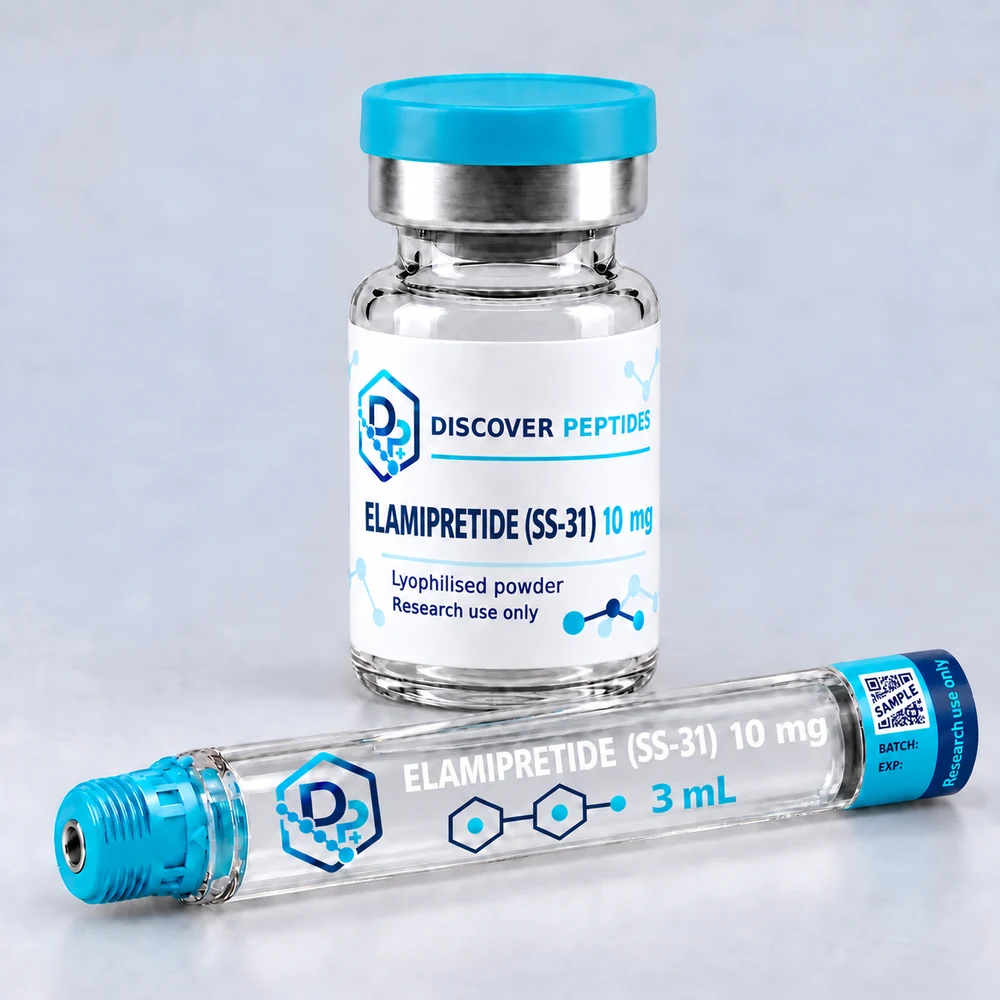
A vial labelled ‘SS-31’, ‘elamipretide’, ‘MTP-131’, ‘Bendavia’, ‘research grade’ or with a CAS number is not thereby equivalent to FORZINITY. Exact sequence, stereochemistry, acetate content, peptide content, purity, sterility, formulation, stability and cold-chain history may be unknown.
Barth syndrome is a serious inherited mitochondrial disease requiring specialist care. New or severe allergic symptoms, breathing difficulty, collapse, marked injection-site swelling, chest symptoms or rapid deterioration in exercise tolerance requires urgent medical assessment.
What is elamipretide acetate?
Elamipretide is a synthetic aromatic-cationic tetrapeptide designed to concentrate at the inner mitochondrial membrane. It associates with cardiolipin, a phospholipid important for mitochondrial membrane architecture and energy production. The active peptide has also been known as SS-31, MTP-131 and Bendavia during development.
Identity distinctions that prevent confusion
What is elamipretide approved or researched for?
On 19 September 2025, the FDA granted accelerated approval to FORZINITY for treatment of Barth syndrome in adults and paediatric patients weighing at least 30 kg. Barth syndrome is caused by pathogenic variants affecting tafazzin and cardiolipin remodelling, commonly producing cardiomyopathy, skeletal-muscle weakness, exercise intolerance and other systemic problems.
The approval was based on improvement in knee-extensor muscle strength, a surrogate measure considered reasonably likely to predict clinical benefit. Continued approval may depend on confirmation of clinical benefit in a required post-approval randomised trial.
Barth syndrome in the specific FDA-authorised population
Skeletal-muscle strength and functional outcomes
Long-term safety and disease course under specialist follow-up
Confirmatory evidence required under accelerated approval
Other potential uses—only if future research confirms them
Elamipretide has been studied in primary mitochondrial myopathy, heart failure, kidney injury, age-related macular degeneration and other disorders involving mitochondrial dysfunction. These programmes should be assessed separately; an approval for Barth syndrome does not establish benefit in another mitochondrial or age-related condition.
Claims about healthy ageing, energy, athletic recovery, cognitive enhancement, weight loss or general “mitochondrial repair” are not approved and lack adequate clinical-outcome evidence. Mitochondrial involvement in a disease is not enough to prove that a mitochondrial-targeting peptide improves that disease.
How does elamipretide work?
Targeting the inner mitochondrial membrane
Elamipretide is attracted to mitochondrial membranes and binds cardiolipin. This interaction is proposed to stabilise cristae architecture, support electron-transport-chain organisation and improve the efficiency of oxidative phosphorylation.
Energy production and oxidative stress
By improving membrane organisation, elamipretide may help electron transfer and ATP production while reducing excessive reactive oxygen species. These mechanistic effects are biologically plausible, but laboratory or biomarker changes do not automatically translate into better strength, vision, heart function or survival.
Why Barth syndrome is a special case
Barth syndrome directly disrupts cardiolipin remodelling. That close connection between disease biology and elamipretide’s target provides a stronger rationale than broad claims for unrelated fatigue or ageing. Even so, the FDA used accelerated approval and requires confirmatory evidence.
What has evidence found?
TAZPOWER and extension evidence
The randomised crossover TAZPOWER trial in Barth syndrome did not meet its prespecified primary endpoints during the blinded treatment period. Longer open-label follow-up reported improvements in several functional measures over time, but open-label results are vulnerable to expectation, selection, maturation and other biases.
Basis of accelerated approval
The FDA reviewed the total evidence and accepted increased knee-extensor muscle strength as a surrogate endpoint reasonably likely to predict meaningful patient benefit. This is real regulatory approval, but not the same evidentiary position as traditional approval based directly on confirmed clinical outcomes.
Primary mitochondrial myopathy
The large phase 3 MMPOWER-3 randomised trial did not show significant benefit over placebo on its primary six-minute walk and fatigue endpoints. This negative result is important and prevents generalising the Barth syndrome approval to all mitochondrial myopathies.
Heart failure
In the phase 2 PROGRESS-HF trial, 28 days of elamipretide did not significantly improve left-ventricular end-systolic volume or ejection fraction compared with placebo. Smaller mechanistic findings do not establish elamipretide as a heart-failure treatment.
Evidence and regulatory position in 2026
Current South African context
SAHPRA’s 2026 peptide-products notice warns that unregistered peptide products promoted for human use have not been evaluated locally for quality, safety or efficacy. A review of publicly accessible SAHPRA resources did not identify a registered elamipretide or FORZINITY professional-information record in South Africa.
US accelerated approval does not automatically confer South African registration, lawful advertising, supply authorisation or reimbursement. Rare-disease access may involve clinical trials or a formal Section 21 pathway, which must be handled through clinicians and SAHPRA. “Research use only” material is not the FDA-authorised finished medicine.
How elamipretide compares with related concepts
Known risks, contraindications and uncertainties
The current FORZINITY label identifies injection-site reactions as the most common adverse reactions. These include redness, pain, swelling, bruising, itching and firmness. Serious hypersensitivity reactions, including anaphylaxis, have been reported and require immediate discontinuation and treatment.
Observe for systemic or severe local hypersensitivity, particularly during early treatment.
Daily injection burden and persistent local reactions may affect adherence and quality of life.
Long-term safety data remain limited because Barth syndrome is very rare and trials are small.
Accelerated approval means the relationship between the strength surrogate and everyday clinical benefit still requires confirmation.
Pregnancy, breastfeeding, paediatric weight groups below the authorised threshold and significant organ impairment require reference to current specialist information.
Safety findings from regulated FORZINITY cannot be transferred to unverified SS-31 powder or compounded material.
Treatment and measurement safeguards
This page deliberately does not provide a personal dose, mixing instruction, syringe-unit conversion or protocol for bulk powder. FORZINITY is a defined prescription injection with weight-based labelling and controlled manufacture. A research vial cannot be converted into the authorised product through arithmetic.
Barth syndrome monitoring may include cardiac evaluation, muscle strength and function, exercise capacity, growth, nutrition, blood counts, metabolic measures and injection-site review. Treatment does not replace multidisciplinary management or genetic counselling.
Common questions
Is elamipretide still experimental?
It is FDA-approved under the accelerated pathway for one defined Barth syndrome population; all other uses remain investigational unless separately authorised.
What does accelerated approval mean?
Approval is based on a surrogate endpoint reasonably likely to predict benefit, with a required confirmatory trial.
Is SS-31 the same as elamipretide?
SS-31 is a development name for the active peptide, but an SS-31-labelled vial is not automatically FORZINITY.
Can it be used for ordinary fatigue or ageing?
No approved indication or adequate clinical-outcome evidence supports those broad claims.
Does it treat every mitochondrial disorder?
No. A large primary mitochondrial myopathy trial failed its primary endpoints.
Does a CAS number prove authenticity?
No. It does not establish stereochemistry, peptide content, salt content, purity, sterility, stability or medicine status.
Is it registered in South Africa?
No public SAHPRA registration was identified in this review; verify directly because regulatory records can change.
Join for research and regulatory updates
Join the future research bulletin for confirmatory-trial results, label changes, safety communications and South African status updates. Subscription does not provide medical advice, rare-disease access, product supply or dosing instructions.
Consent wording for the future form: “I agree to receive evidence and regulatory updates by email. This service does not provide medical advice, personal dosing instructions or product supply.”
Sources and further reading
US Food and Drug Administration. FDA Grants Accelerated Approval to First Treatment for Barth Syndrome. 19 September 2025.
US FDA. FORZINITY (elamipretide) prescribing information. NDA 215244; initial US approval 2025.
Reid Thompson W, et al. Long-term efficacy and safety of elamipretide in patients with Barth syndrome: 168-week open-label extension of TAZPOWER. Genetics in Medicine. 2024. PMID 38602181.
Karaa A, et al. Efficacy and Safety of Elamipretide in Primary Mitochondrial Myopathy: MMPOWER-3 Randomized Clinical Trial. Neurology. 2023. PMID 37268435.
Butler J, et al. PROGRESS-HF phase 2 trial. Journal of Cardiac Failure. 2020;26:429-437. PMID 32068002.
ClinicalTrials.gov. NCT03098797: TAZPOWER trial in Barth syndrome.
SAHPRA. Peptide Products – Public Information. Published 2026; accessed 7 September 2026.
PubChem. Elamipretide and elamipretide acetate compound records.
Editorial method: current regulator documents and peer-reviewed controlled trials were prioritised over commercial pages. Approval was kept separate from unapproved mitochondrial claims. Review after confirmatory or regulatory changes, and no later than March 2027.



Reviews
There are no reviews yet.