

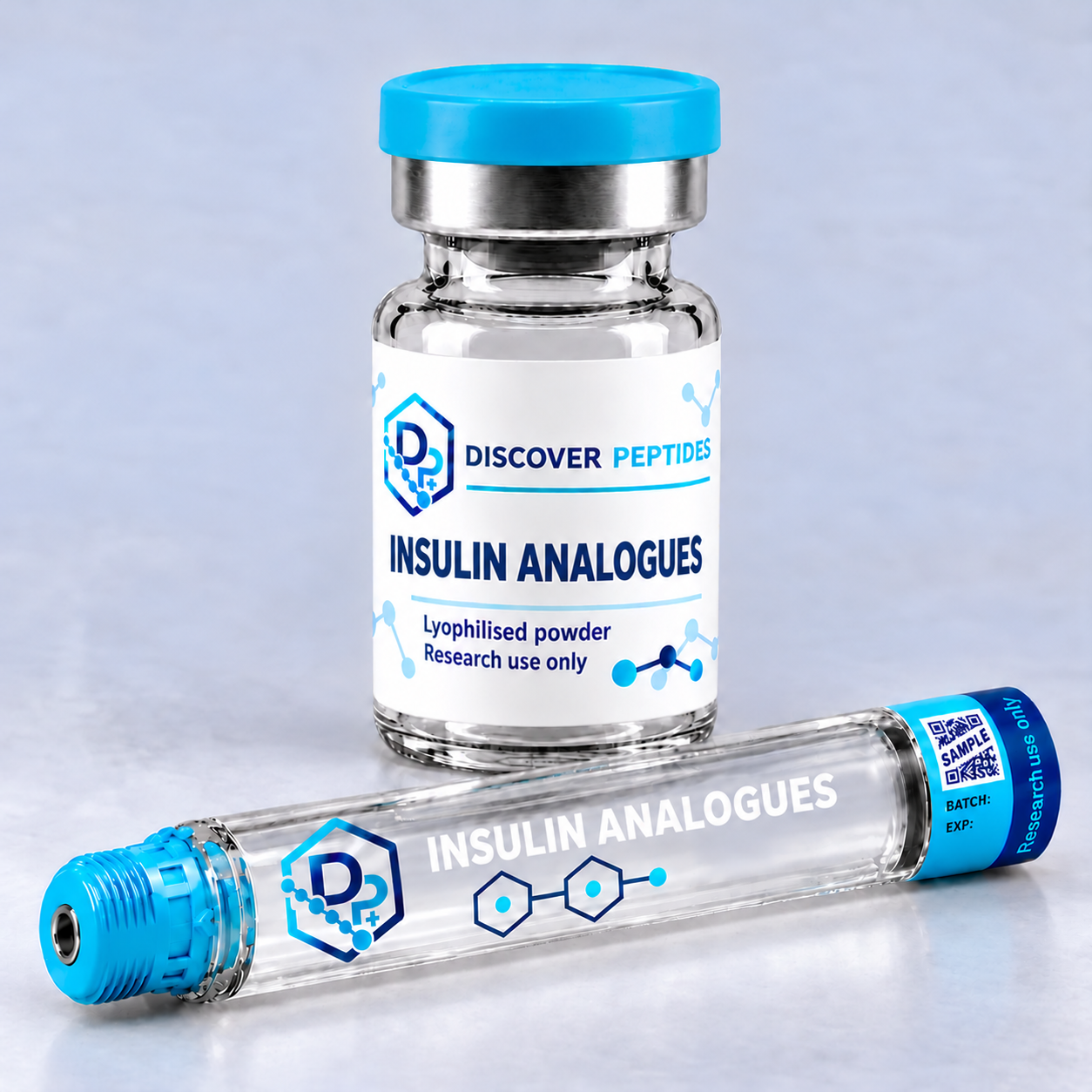
Insulin Analogues
R850.00
An evidence-based, plain-language guide to rapid-, short-, intermediate-, long- and ultra-long-acting insulin, biosimilars, devices, major safety risks and South African context.
Please note, to maintain the quality and integrity of every product, all orders are fulfilled on a made-to-order basis. Please allow 7–14 days for processing and delivery. You will receive tracking details as soon as your order is dispatched.
Research Use Only.
This product is supplied strictly for research use. It is not intended for human consumption, administration, therapeutic use, diagnosis, or veterinary use. Customers are responsible for ensuring that their purchase and use of research products comply with applicable laws, regulations, and institutional requirements.
- Research Focused
- Clear Specifications
- Transparent Pricing
- South African Supply
POPULAR 2026 | RESEARCH LIBRARY
Insulin analogues
An evidence-based, plain-language guide to rapid-, short-, intermediate-, long- and ultra-long-acting insulin, biosimilars, devices, major safety risks and South African context.
Contents
What insulin and insulin analogues are
Important information and disclaimer
Approved and researched uses
Potential future developments
How they work
What evidence has found
Current regulatory and South African status
How insulin types compare
Risks and uncertainties
Treatment, device and emergency safeguards
Common questions
Join for updates
Sources
Important information and disclaimer
This page is for general education. Insulin is a prescription, life-sustaining medicine. People with type 1 diabetes require a continuous source of insulin; stopping it or losing delivery through a pump can cause diabetic ketoacidosis (DKA), coma and death. This page does not diagnose diabetes, select a product, change a dose, calculate carbohydrates or corrections, interpret pump settings, or replace an individual sick-day and emergency plan.
Insulins are not interchangeable merely because a label says ‘insulin’, ‘rapid acting’, ‘basal’, ‘U-100’, ‘biosimilar’ or shows a familiar brand. Molecule, concentration, onset and duration, device, authorised route and instructions can differ. Never withdraw insulin from a pen into a syringe, share a pen, transfer it into an unvalidated cartridge, or use a product whose identity, concentration, storage history or sterility is uncertain.
Severe hypoglycaemia, seizure, loss of consciousness, inability to swallow, suspected DKA, repeated vomiting, deep or rapid breathing, severe dehydration, confusion, or persistent very high glucose with ketones is an emergency. Use the person-specific emergency plan and obtain urgent medical help. When pump delivery is interrupted, waiting for supplements, food remedies or an unverified replacement is unsafe.
What are insulin and insulin analogues?
Human insulin is a 51-amino-acid peptide hormone made of A and B chains linked by disulfide bonds. It enables glucose uptake and storage and suppresses glucose production and ketone formation. Recombinant human insulin matches the human sequence. An insulin analogue contains deliberate sequence or chemical changes that alter absorption, stability or duration while retaining insulin-receptor activity.
Names and products that must not be confused
What are insulin products approved or researched for?
Type 1 diabetes
Insulin replacement is essential in type 1 diabetes. Treatment normally combines background basal delivery with meal and correction insulin, or uses rapid-acting insulin continuously through a pump. Adjunct medicines may sometimes be studied or prescribed, but none makes insulin optional. Abrupt interruption can lead to ketone production and DKA within hours, particularly with pump therapy because no long-acting depot is present.
Type 2 diabetes and other forms
Insulin is used when type 2 diabetes cannot be controlled adequately with other measures, when marked hyperglycaemia or catabolic symptoms are present, and in selected acute, perioperative or pregnancy settings. It is also used in pancreatic diabetes and other insulin-deficient states. The exact product and plan depend on physiology, lifestyle, kidney and liver function, pregnancy, access, monitoring and hypoglycaemia risk.
Hospital and emergency care
Selected short- or rapid-acting insulin products may be given intravenously under tightly controlled clinical protocols for DKA, hyperkalaemia and critical-care glucose management. That is not equivalent to home injection. Intravenous insulin requires verified concentration, frequent glucose and electrolyte monitoring, and trained supervision.
Other potential developments – only if evidence and regulation support them
Research aims to make insulin faster at meals, flatter and longer between doses, more glucose-responsive, easier to manufacture and store, and simpler to deliver. Weekly basal insulin, oral or inhaled delivery, closed-loop systems, dual-hormone pumps, stem-cell-derived islet replacement and immune therapies are distinct approaches. A promising trial does not make a product interchangeable with established insulin or remove the need for monitoring.
The most clinically important innovation may be a safer information layer rather than a new molecule: verified cartridge identity, concentration, expiry, temperature history, device compatibility and machine-readable instructions could reduce selection and transcription errors. Such technology must preserve validated product-specific controls and cannot convert heterogeneous insulins into one universal dose.
How does insulin work?
Metabolic replacement
Insulin binds the insulin receptor and triggers signalling that moves glucose transporters to cell surfaces, promotes glycogen, fat and protein storage, and restrains liver glucose output, fat breakdown and ketone production. Too little effective insulin causes hyperglycaemia and ketosis; too much relative to food, activity or current physiology causes hypoglycaemia.
How analogue design changes time-action
Rapid analogues are engineered to reduce self-association and move from the injection site more quickly. Basal analogues use precipitation, albumin binding or multi-hexamer depots to slow release. Formulation also matters: two products containing a related molecule may differ in excipients, concentration, device and authorised pump or intravenous use.
Why action is never perfectly fixed
Label time-action descriptions are population averages, not a stopwatch. Injection site, depth, temperature, exercise, local blood flow, illness, kidney function, lipohypertrophy, dose size, device performance and storage damage can change absorption. Continuous glucose monitoring improves visibility but does not prove that insulin was delivered.
What has evidence found?
Intensive control and complications
The Diabetes Control and Complications Trial established that intensive insulin therapy substantially reduced microvascular complications in type 1 diabetes compared with conventional treatment, while increasing severe hypoglycaemia. Long-term follow-up showed durable cardiovascular benefit. Modern analogues, sensors and automated delivery seek to improve control while reducing treatment burden and hypoglycaemia.
Rapid and basal analogues
Compared with regular human insulin, rapid analogues generally improve post-meal flexibility and reduce some hypoglycaemia outcomes, although absolute differences vary. Long-acting analogues generally provide a less pronounced peak and may reduce nocturnal hypoglycaemia compared with NPH. Clinical advantage, affordability and availability must be considered together; human insulin remains effective when used correctly.
Automated insulin delivery
Hybrid closed-loop systems use sensor glucose, an algorithm and a pump to adjust insulin delivery. Trials consistently improve time in range for many users, but the system still depends on functioning infusion hardware, correct insulin, accurate data and user response to alarms. A blocked cannula, empty reservoir, disconnection or spoiled insulin can cause rapid metabolic deterioration.
Evidence position in 2026
Current regulatory and South African status
Multiple recombinant human insulins and analogues are authorised internationally as biological medicines. Each authorisation applies to a particular manufacturer, formulation, concentration, container and device. US labels for products such as insulin lispro, faster insulin aspart, insulin glargine and insulin degludec emphasise hypoglycaemia, medication errors, potassium lowering, hypersensitivity and the need for increased monitoring when regimens change.
South Africa has SAHPRA-approved professional information for insulin products including Fiasp (insulin aspart) and Lantus (insulin glargine), and patient information for products including Tresiba (insulin degludec). The publicly accessible Fiasp professional information identifies it as Schedule 3. Registration and availability must be checked for the exact brand, strength, device and presentation; a listing or approval for one product does not extend to imported cartridges, online vials or locally refilled devices.
Insulin access is also a public-health issue. WHO identifies insulin access and affordability as critical, and insulin is included within essential-medicine policy. Regulatory quality, dependable cold-chain handling, compatible needles or infusion sets, glucose and ketone monitoring, education and uninterrupted supply are part of safe access—not optional extras.
How major insulin categories compare
Known risks and uncertainties
Hypoglycaemia is the principal immediate risk. Symptoms may include sweating, tremor, hunger, palpitations, confusion, behaviour change, impaired coordination, seizure or unconsciousness. Warning symptoms can be reduced after recurrent episodes, during sleep, with some medicines or after long-duration diabetes.
Medication errors can occur between rapid and basal insulin, between similar pen colours or names, and between U-100, U-200, U-300 and U-500 products. Always verify the exact label and device display.
Changing insulin product, concentration, delivery method, injection site, activity, food intake, illness or kidney/liver function can alter glucose and requires closer monitoring.
Insulin can lower potassium, sometimes seriously, especially with intravenous treatment or other potassium-lowering factors.
Severe allergy and local injection reactions can occur. Repeated use of abnormal fatty or amyloid skin areas can make absorption unpredictable.
Pump or infusion-set occlusion, leakage, disconnection, battery or algorithm problems, an empty reservoir and heat-damaged insulin can interrupt delivery.
All insulin promotes some weight gain in many users when deficient insulin is replaced or glucose loss in urine falls; this does not justify unsafe restriction or omission.
Insulin stacking from repeated corrections before earlier insulin has finished acting can cause delayed hypoglycaemia. Personal correction rules belong in the clinical plan.
Heat, freezing and use beyond product-specific in-use limits can reduce potency. Clear insulin that is cloudy, coloured, particulate or otherwise abnormal should be handled according to its product instructions.
Treatment, device and emergency safeguards
This page deliberately excludes personal unit calculations, insulin-to-carbohydrate ratios, correction factors, basal rates, pump settings, pen clicks, syringe conversions and switching tables. Insulin is prescribed and displayed in units, but units are not a volume and concentrations differ. The dose window on a compatible pen should be used as labelled; never calculate a concentrated pen dose from millilitres or unmarked clicks.
Every user needs an individual plan for hypoglycaemia, illness, ketone testing, pump interruption, travel and unavailable supplies. Backup insulin and compatible administration equipment, glucose and ketone monitoring, fast-acting carbohydrate and prescribed glucagon should be accessible as appropriate. Family, school or workplace helpers should know where they are and when to call emergency services.
Before every administration, verify the person, insulin name, concentration, intended time, device and displayed units. Do not share pens or needles. Pumps and cartridges must use only the insulins, reservoirs and infusion sets authorised by their manufacturers. A smart device should read validated medicine data and apply hard safety limits; it should never infer identity or concentration from cartridge shape alone.
Common questions
Is an insulin analogue a peptide?
Yes. It is a modified form of the peptide hormone insulin, usually produced by recombinant biotechnology.
Can insulin be stopped when glucose looks normal?
Not in type 1 diabetes. Normal readings may reflect insulin already acting; background insulin remains necessary to prevent ketosis.
Are all clear insulins rapid acting?
No. Several basal insulins are also clear. Appearance cannot identify the medicine—read the full label.
Are U-100 and U-200 the same strength?
No. They contain different units per millilitre. Compatible pens display units directly; transferring insulin or converting by volume can cause serious overdose.
Can a pump user wait after a flow-blocked alarm?
Delivery interruption can become urgent because rapid insulin clears quickly. Follow the personal pump-failure plan, check glucose and ketones as directed, use verified backup insulin/equipment and seek urgent help when thresholds or symptoms require it.
Is a biosimilar insulin a generic?
It is a regulated biological product shown to be highly similar to a reference product, not simply a chemically identical small-molecule generic. Switching rules are jurisdiction- and product-specific.
Can GLP-1 medicines replace insulin?
No. They may be used in selected people with type 2 diabetes and occasionally as specialist adjuncts, but they do not replace insulin in type 1 diabetes or treat DKA.
Can insulin damaged by heat be corrected by taking more?
Potency loss cannot be judged reliably by appearance or compensated safely by guesswork. Replace suspect insulin through the verified supply route and follow the clinical plan.
Join for research and regulatory updates
Join the future research bulletin for new insulin formulations, biosimilars, automated delivery, cartridge and device standards, safety alerts, access developments and South African regulatory updates. Subscription does not provide personal insulin calculations, pump settings, prescribing, emergency triage or product supply.
Consent wording for the future form: “I agree to receive evidence, device-safety and regulatory updates by email. This service does not provide medical advice, personal insulin calculations or product supply.”
Sources and further reading
World Health Organization. Diabetes fact sheet; current information on insulin access and treatment.
World Health Organization. Keeping the 100-year-old promise: making insulin access universal. Global report. 2021.
South African Health Products Regulatory Authority. Fiasp approved professional information, February 2022.
South African Health Products Regulatory Authority. Lantus professional information, 30 September 2016.
South African Health Products Regulatory Authority medicines information portal. Tresiba patient information.
US National Library of Medicine DailyMed. HUMALOG (insulin lispro) prescribing information, current label accessed 7 September 2026.
US National Library of Medicine DailyMed. FIASP (insulin aspart) prescribing information.
US National Library of Medicine DailyMed. LANTUS (insulin glargine) prescribing information.
US National Library of Medicine DailyMed. TRESIBA (insulin degludec) prescribing information.
Diabetes Control and Complications Trial Research Group. The effect of intensive treatment of diabetes on long-term complications in insulin-dependent diabetes mellitus. New England Journal of Medicine. 1993.
Nathan DM, et al. Intensive diabetes treatment and cardiovascular disease in patients with type 1 diabetes. New England Journal of Medicine. 2005.
American Diabetes Association Professional Practice Committee. Standards of Care in Diabetes—2026: Pharmacologic approaches and diabetes technology sections.
Editorial method: regulator-approved product information, WHO material, landmark outcome evidence and professional standards were prioritised. Class descriptions do not replace the label of an exact insulin, concentration or device. Review after major registration, safety, supply or device changes, and no later than March 2027.
Lyophilized: Stable at −20°C for up to 24 months when kept dry and protected from light.
Reconstituted: Store at 2–8°C. Use within 28 days. Do not freeze after reconstitution.
Diluent: Bacteriostatic water (BW) recommended for multi-dose use. See Protocols.
Research Use Only.
This product is supplied strictly for research use. It is not intended for human consumption, administration, therapeutic use, diagnosis, or veterinary use. Customers are responsible for ensuring that their purchase and use of research products comply with applicable laws, regulations, and institutional requirements.
You may also research
Related Compounds
Reviews
There are no reviews yet.