POPULAR 2026 | RESEARCH LIBRARY
Kisspeptin-10 (KP-10)
An evidence-based, plain-language information page on the active kisspeptin fragment, reproductive-hormone research, uncertainties, identity distinctions and South African context.
Contents
What Kisspeptin-10 is
Important information and disclaimer
Researched uses
Potential future uses
How it works
What evidence has found
South African regulatory context
How it compares
Risks and uncertainties
Treatment and measurement safeguards
Common questions
Join for updates
Sources
Important information and disclaimer
This page is for general education. Kisspeptin-10 is an investigational research peptide and is not an approved self-treatment for fertility, low testosterone, libido, menopause or any other condition. This page does not diagnose a reproductive disorder, recommend treatment, replace specialist care, or provide personal injection, nasal or dosing instructions.
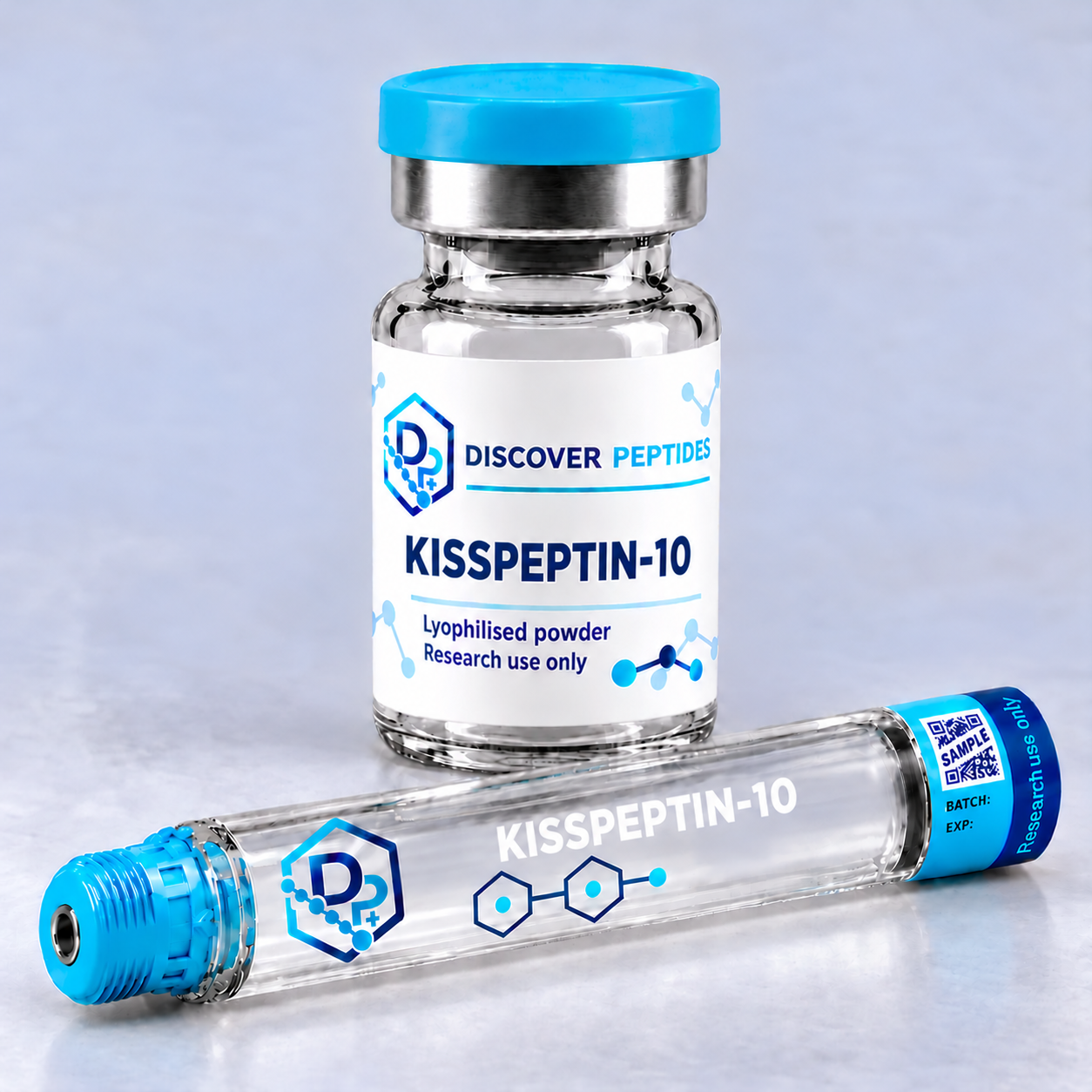
A vial labelled ‘KP-10’, ‘kisspeptin’, ‘metastin’, ‘research grade’ or with a CAS number does not establish human-medicine quality. Sequence identity, terminal chemistry, peptide content, purity, sterility, formulation, stability and storage history may be unknown.
Manipulating the hypothalamic-pituitary-gonadal axis may alter ovulation, testosterone, pregnancy potential and hormone-sensitive conditions. Severe headache, visual or neurological symptoms, marked pelvic pain, heavy bleeding, severe allergic symptoms or suspected ovarian hyperstimulation requires urgent medical assessment.
What is Kisspeptin-10?
Kisspeptin-10 is the shortest naturally occurring fragment of the KISS1-derived kisspeptin family that retains full activity at the kisspeptin receptor, KISS1R (formerly GPR54). It comprises the shared C-terminal ten amino acids of longer kisspeptins and is sometimes called KP-10 or metastin(45-54).
Identity distinctions that prevent confusion
What is Kisspeptin-10 researched for?
Human research has mainly used kisspeptin as a physiological probe or experimental activator of the reproductive axis. KP-10 can stimulate luteinising hormone (LH) and follicle-stimulating hormone (FSH), usually through hypothalamic release of gonadotropin-releasing hormone (GnRH).
Mapping normal reproductive-hormone responses in women and men
Investigating hypothalamic amenorrhoea and other forms of reproductive-axis dysfunction
Testing pituitary and hypothalamic responsiveness in delayed or disordered puberty
Studying male gonadotropin and testosterone responses
Exploring brain processing related to sexual and emotional cues
These are research purposes, not approved indications. An observed rise in LH or testosterone is a laboratory endpoint and does not prove restored fertility, pregnancy, improved libido, muscle gain or long-term health benefit.
Other potential uses—only if future research confirms them
The broader kisspeptin field includes fertility-treatment research, safer triggering of egg maturation during IVF, diagnostic testing of hypothalamic function, and possible treatment of selected hypogonadal disorders. Much of the strongest IVF evidence used Kisspeptin-54 rather than KP-10, so the findings must not be merged.
Research has also explored sexual and emotional brain processing and metabolic links, but these findings are early and do not establish treatment for low libido, depression, obesity or relationship difficulties. Longer-acting KISS1R agonists and antagonists are separate drug-development programmes.
How does Kisspeptin-10 work?
The reproductive-axis gatekeeper
Kisspeptin binds KISS1R on GnRH neurons and stimulates GnRH release. GnRH then signals the pituitary to release LH and FSH. In women these hormones coordinate follicle development, ovulation and sex-steroid production; in men LH supports testicular testosterone production and FSH supports spermatogenesis.
Context changes the response
Responses vary with sex, menstrual-cycle phase, baseline gonadal function, sex-steroid feedback and route or pattern of exposure. Human studies have found sexual dimorphism, meaning the same exposure can produce different hormone responses in women and men.
Pulses, continuous exposure and desensitisation
The reproductive axis depends on timing. Continuous or repeated stimulation can produce tachyphylaxis or altered responsiveness, while intermittent exposure may preserve signalling. A 2026 small controlled study in healthy men found that intermittent KP-10 infusion sustained gonadotropin responses over 12 days; this is mechanistic research, not a home-use regimen.
What has evidence found?
Acute human hormone studies
Controlled studies show that KP-10 can rapidly raise LH, and in some settings FSH and testosterone. The magnitude and duration depend on biological context. These studies establish target engagement but are generally small and do not establish clinical outcomes.
Hypothalamic amenorrhoea research
Kisspeptin administration can stimulate reproductive hormones in women with hypothalamic amenorrhoea, but repeated exposure may attenuate the response. Key longer-term studies used Kisspeptin-54, illustrating why peptide identity and schedule matter.
IVF egg-maturation research
Kisspeptin-54 has triggered oocyte maturation and live births in IVF research, including women at increased risk of ovarian hyperstimulation syndrome. This is a major proof of concept for KISS1R activation, but it is not direct evidence that KP-10 vials are safe or effective for fertility treatment.
New 2026 male study
A randomised, placebo-controlled mechanistic study involving small groups of healthy men reported dose-related acute LH, FSH and testosterone increases and sustained gonadotropin stimulation with intermittent subcutaneous KP-10 infusion for 12 days. Larger patient trials are needed before therapeutic conclusions can be drawn.
Evidence and regulatory position in 2026
Current South African context
SAHPRA’s 2026 public information on peptide products warns that unregistered peptide products promoted for human use have not been evaluated for quality, safety or efficacy. A review of publicly accessible SAHPRA resources did not identify a registered Kisspeptin-10 medicine or approved South African professional information.
This does not prove that no clinical-trial, Section 21 or later access route exists. Current status should be verified directly with SAHPRA and a reproductive-medicine specialist. “Research use only” labelling does not authorise therapeutic supply, advertising or self-administration.
How Kisspeptin-10 compares with reproductive medicines
Known risks, contraindications and uncertainties
KP-10 does not have an approved product label defining a complete adverse-event profile. Short research studies have often reported acceptable acute tolerability, but sample sizes and exposure periods are too limited to establish safety for repeated or unsupervised use.
Possible effects include headache, flushing, nausea, abdominal or pelvic symptoms and injection-site reactions.
Hormonal stimulation could affect ovulation timing, fertility and pregnancy risk; pregnancy exposure has not been established as safe.
People with hormone-sensitive tumours or unexplained reproductive symptoms require specialist assessment before any experimental hormonal manipulation.
Ovarian stimulation may carry risks including multiple follicle development and ovarian hyperstimulation when combined with fertility medicines.
Continuous or poorly timed exposure may blunt responses rather than improve them.
Long-term effects on reproductive function, mood, metabolism, cardiovascular health and cancer risk remain inadequately defined.
Treatment and measurement safeguards
This page deliberately does not give a dose, mixing instruction, syringe-unit conversion, nasal formula or fertility protocol. Published studies used precisely characterised material, research governance, timed hormone sampling and specialist monitoring. Milligram-for-milligram substitution between KP-10, KP-54 and synthetic agonists is scientifically invalid.
Relevant clinical assessment may include pregnancy testing, menstrual and fertility history, LH, FSH, estradiol or testosterone, prolactin, thyroid status, pelvic assessment, semen analysis and evaluation for pituitary or hypothalamic disease. Results must be interpreted by timing and clinical context.
Common questions
Is Kisspeptin-10 an approved fertility medicine?
No. It is investigational; promising kisspeptin fertility research does not constitute general approval.
Is KP-10 the same as KP-54?
No. KP-10 is the active ten-amino-acid C-terminal fragment; KP-54 is longer and has different pharmacokinetics.
Can it increase testosterone?
It can raise LH and testosterone transiently in some controlled male studies, but that does not establish treatment for hypogonadism.
Is it a libido peptide?
Kisspeptin participates in reproductive and behavioural signalling, but KP-10 is not an approved libido treatment.
Can it be used in IVF at home?
No. Fertility protocols require specialist medicines, ultrasound and laboratory monitoring; much kisspeptin IVF evidence used KP-54.
Does a CAS number prove authenticity?
No. It does not prove sequence, amidation, peptide content, purity, sterility, stability or medicine status.
Is it registered in South Africa?
No public SAHPRA registration was identified in this review; verify directly because regulatory records can change.
Join for research and regulatory updates
Join the future research bulletin for major trial results, safety findings and South African status changes. Subscription does not provide medical advice, fertility treatment, product supply or dosing instructions.
Consent wording for the future form: “I agree to receive evidence and regulatory updates by email. This service does not provide medical advice, personal dosing instructions or product supply.”
Sources and further reading
SAHPRA. Peptide Products – Public Information. Published 2026; accessed 7 September 2026.
Dhillo WS, et al. Kisspeptin-54 stimulates the hypothalamic-pituitary-gonadal axis in human males. Journal of Clinical Endocrinology & Metabolism. 2005.
Jayasena CN, et al. Twice-weekly Kisspeptin-54 for 8 weeks in women with hypothalamic amenorrhoea. Clinical Endocrinology. 2010. PMID 20980998.
Jayasena CN, et al. Kisspeptin-54 triggers egg maturation in women undergoing IVF. Journal of Clinical Investigation. 2014.
Chan YM, et al. Kisspeptin as a test of hypothalamic dysfunction in pubertal and reproductive disorders. 2025. PMID 39834030.
Yeung AC, et al. Chronic subcutaneous Kisspeptin-10 stimulates gonadotropin secretion for 12 days in healthy men. European Journal of Endocrinology. 2026;195:206-216. PMID 42549827.
ClinicalTrials.gov. NCT05633966: Kisspeptin administration subcutaneously to patients with reproductive disorders.
PubChem. Kisspeptin-10 compound record, CID 25240297.
Editorial method: regulator material, registered trials and peer-reviewed human studies were prioritised over commercial pages. Evidence for different kisspeptin lengths was kept separate. Review after major trial or regulatory changes, and no later than March 2027.

Reviews
There are no reviews yet.