POPULAR 2026 | RESEARCH LIBRARY
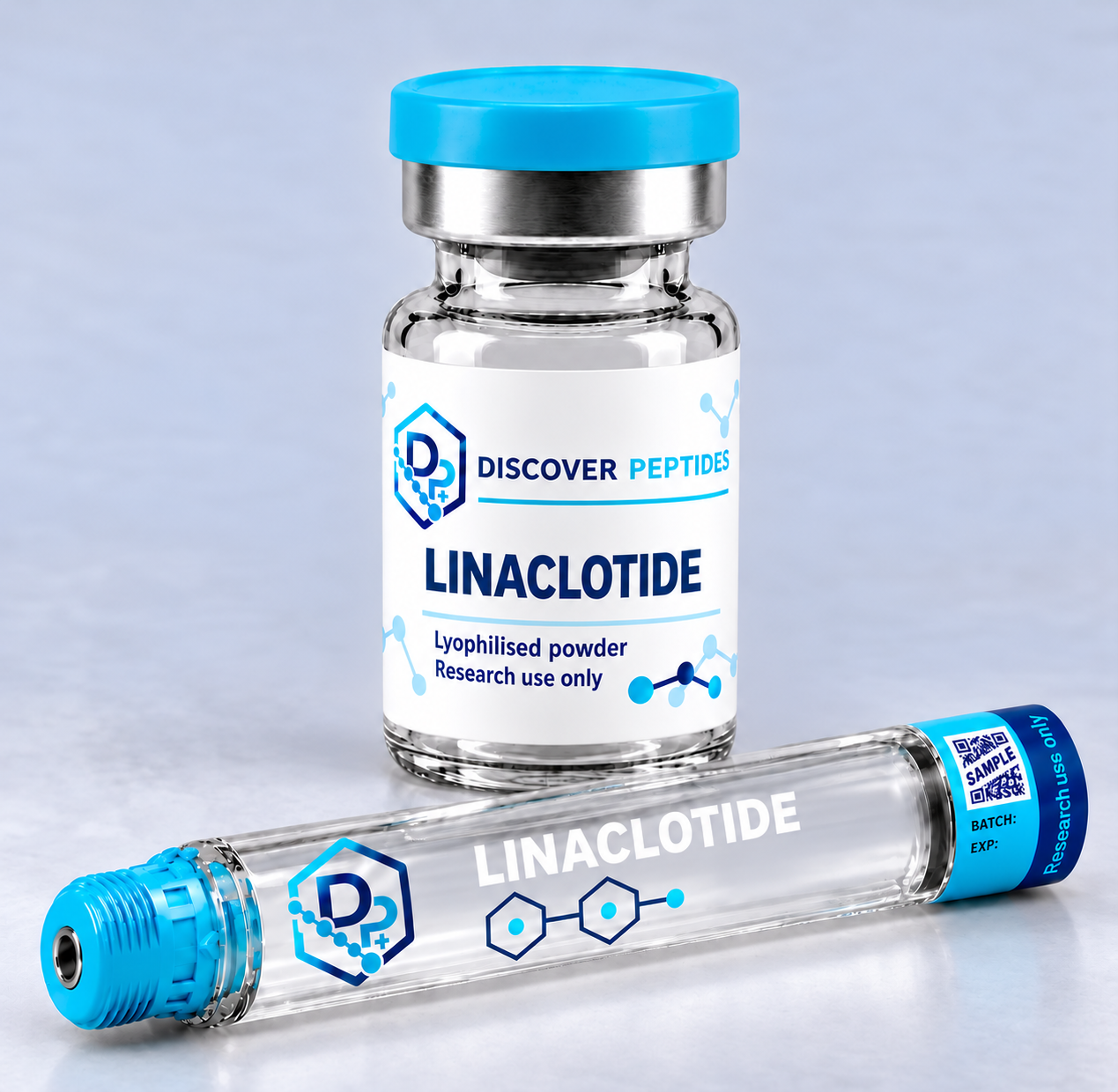
Linaclotide
An evidence-based, plain-language information page on this locally acting peptide medicine for constipation-related bowel disorders, including its safety and South African status.
Contents
What linaclotide is
Important information and disclaimer
Approved and researched uses
Potential future uses
How it works
What evidence has found
Current regulatory and South African status
How it compares
Risks and uncertainties
Use and product safeguards
Common questions
Join for updates
Sources
Important information and disclaimer
This page is for general education. Linaclotide is a prescription medicine in jurisdictions where it is authorised. Symptoms such as constipation, abdominal pain and bloating have many possible causes, including conditions that require different or urgent care. This page does not diagnose a bowel disorder, recommend treatment or replace registered product information.
A capsule, powder or raw material labelled ‘linaclotide’, ‘Constella’, ‘Linzess’ or ‘research grade’ is not thereby equivalent to an authorised medicine. Identity, peptide content, purity, formulation, release characteristics, stability and manufacturing controls may be unknown. Brand names belong to specific finished products and must not be applied to unrelated material.
Severe or persistent diarrhoea, signs of dehydration, fainting, confusion, very low urine output, blood in stool, marked abdominal swelling, repeated vomiting, fever with abdominal pain, or symptoms suggesting bowel obstruction require prompt medical assessment.
What is linaclotide?
Linaclotide is a synthetic 14-amino-acid peptide that acts mainly on the inner surface of the intestine. It is a guanylate cyclase-C, or GC-C, receptor agonist. Unlike many injectable peptides discussed online, authorised linaclotide is an oral capsule medicine designed for local action in the gastrointestinal tract.
Identity distinctions that prevent confusion
What is linaclotide approved or researched for?
Approved indications vary by jurisdiction and age. Under the current United States label, LINZESS is authorised for irritable bowel syndrome with constipation (IBS-C) in adults and in children aged seven years and older, chronic idiopathic constipation (CIC) in adults, and functional constipation in children aged six years and older. The European Union authorisation for CONSTELLA is narrower: symptomatic treatment of moderate to severe IBS-C in adults.
IBS-C: abdominal pain associated with altered bowel habits and constipation
Chronic idiopathic constipation in adults under the United States label
Functional constipation in children aged six years and older under the United States label
Paediatric IBS-C from age seven under the United States label, approved in 2025
The diagnosis matters. Constipation caused by obstruction, medicines, neurological disease, endocrine disease, pelvic-floor dysfunction or another gastrointestinal condition may need a different approach. Linaclotide is not a general detoxification or weight-loss product.
Other potential uses—only if future research confirms them
Research has explored GC-C signalling and linaclotide in additional disorders involving visceral pain, bowel function and gut-brain signalling. Future work may refine which symptom patterns, biomarkers or patient groups are most likely to respond and how to manage overlap between IBS-C and other functional gastrointestinal disorders.
Potential biological effects beyond authorised bowel indications should not be converted into claims for inflammation, cancer prevention, microbiome correction, metabolic disease or general wellness without adequate clinical evidence and regulatory review.
How does linaclotide work?
Activation on the intestinal surface
Linaclotide binds GC-C receptors on the luminal surface of intestinal epithelial cells. Receptor activation increases cyclic guanosine monophosphate (cGMP) inside the cells. This activates pathways that increase chloride and bicarbonate secretion into the intestinal lumen; water follows, helping soften stool and speed intestinal transit.
Pain signalling
Some cGMP is released outside the epithelial cells. Preclinical and clinical evidence supports reduced signalling from pain-sensing visceral nerves, which may help improve abdominal pain in IBS-C. Symptom relief is not immediate or universal, and the precise contribution of each pathway varies between patients.
Why systemic exposure is low
Linaclotide and its active metabolite are minimally absorbed after oral use and act mainly within the gastrointestinal tract. The peptide is broken down in the intestine into smaller peptides and amino acids. Low measurable blood exposure does not mean the medicine has no important risks; excessive intestinal fluid secretion can still cause serious dehydration.
What has evidence found?
Adult IBS-C trials
Randomised placebo-controlled trials found that linaclotide improved abdominal pain and bowel-movement outcomes in a proportion of adults with IBS-C. The European assessment summarised two studies involving 1,608 patients. Benefits were clinically meaningful for responders, but approximately half of participants did not achieve adequate overall benefit.
In one pivotal study, 55% of linaclotide-treated patients achieved at least a 30% improvement in pain and discomfort for at least six of 12 weeks, compared with 42% receiving placebo. Thirty-seven percent were considerably or completely relieved of overall symptoms compared with 19% on placebo. These figures show both benefit and the substantial non-response rate.
Chronic idiopathic constipation
Adult CIC trials showed increases in complete spontaneous bowel movements and improvements in stool consistency, straining and related symptoms. Trial definitions and endpoints differ from ordinary occasional constipation, so results should not be extrapolated to every person who is constipated.
Paediatric evidence and label expansion
United States paediatric approvals followed age-specific trials together with extrapolation from adult evidence. In 2025, the FDA approved linaclotide for IBS-C from age seven, based on adult evidence and a 12-week randomised trial in patients aged seven to 17. Diarrhoea remained the most common adverse effect. The boxed warning continues to prohibit use in children younger than two because of the risk of serious dehydration.
Evidence and regulatory position in 2026
Current regulatory and South African status
Linaclotide is an established prescription medicine in major jurisdictions. LINZESS was first approved in the United States in 2012 and its label now includes several adult and paediatric indications. CONSTELLA received European Union marketing authorisation on 26 November 2012; its authorised indication remains moderate to severe IBS-C in adults.
The September 2026 review found no publicly identifiable linaclotide, LINZESS or CONSTELLA professional-information entry in SAHPRA’s online PI/PIL repository. This is not conclusive proof that no registration, older record, section 21 authorisation or lawful access route exists. The website should therefore avoid claiming ordinary South African registration or supply unless the exact product is verified with SAHPRA and a lawful medicine supplier.
Foreign approval does not authorise South African importation, compounding, promotion, dispensing or sale. The exact product, indication, patient age, strength and supply route must be assessed under South African law.
How linaclotide compares with other constipation medicines
Known risks, contraindications and uncertainties
Diarrhoea is the principal adverse effect and can be severe. Other reported effects include abdominal pain, bloating, gas and abdominal distension. Treatment-related urgency or stool leakage may occur. Persistent diarrhoea can cause dehydration, dizziness, fainting, low potassium and other electrolyte or acid-base disturbances.
Do not use in patients with known or suspected mechanical gastrointestinal obstruction.
The US boxed warning contraindicates use in children younger than two years because animal data showed potentially fatal dehydration.
For severe diarrhoea, authorised information advises stopping or suspending the medicine and rehydrating; urgent assessment may be required.
New rectal bleeding, unexplained weight loss, anaemia, fever, persistent vomiting or night symptoms should not be assumed to be IBS.
Pregnancy and breastfeeding decisions require professional assessment even though systemic exposure is negligible.
Opening or mixing a capsule, where permitted by a specific label, must follow that exact product’s instructions; it does not authorise homemade formulations.
Use and product safeguards
This page deliberately does not provide a personal dose or instructions for reproducing capsules from raw peptide. Authorised strengths and instructions differ by indication and age. The capsule formulation, storage, stability and route are part of the evidence package.
The medicine is not absorbed like a typical oral tablet and is not intended for injection, nasal use or sublingual use. Changing the route defeats the studied local delivery concept and introduces unknown safety and sterility risks.
Response should be reviewed rather than continuing indefinitely without benefit. European information specifically recommends reconsidering the benefit-risk balance when symptoms have not improved after four weeks. Patients with severe diarrhoea or warning signs need earlier review.
Common questions
Is linaclotide really a peptide?
Yes. It is a 14-amino-acid peptide with three disulfide bonds, but the authorised medicine is swallowed and acts mainly on the intestinal surface.
Is it a laxative?
It is an intestinal secretagogue used for defined constipation-related disorders. It increases intestinal fluid and transit, but differs mechanistically from common osmotic or stimulant laxatives.
Does it cure IBS-C?
No. It can improve symptoms in some patients, but IBS-C is chronic and many trial participants did not achieve adequate overall relief.
Can it be used for weight loss?
No authorised indication supports weight loss. Fluid loss from diarrhoea is not healthy fat loss and can be dangerous.
Can children use it?
US approvals include functional constipation from age six and IBS-C from age seven. It must not be used under age two, and jurisdiction-specific paediatric approval must be checked.
Is it registered in South Africa?
No public entry was identified in SAHPRA’s online PI/PIL repository during this review. Registration and lawful availability must be confirmed for the exact product.
Is linaclotide the same as plecanatide?
No. Both activate GC-C, but they are different peptide sequences with different products, evidence and regulatory status.
Join for research and regulatory updates
Join the future research bulletin for important label changes, paediatric evidence, safety communications and South African registration or availability updates. Subscription does not provide medical advice, prescribing, product supply or personal dosing instructions.
Consent wording for the future form: “I agree to receive evidence and regulatory updates by email. This service does not provide medical advice, personal dosing instructions or product supply.”
Sources and further reading
US Food and Drug Administration. LINZESS (linaclotide) prescribing information, application 202811, revision 2026.
US Food and Drug Administration. FDA approves first drug for children 7 years and older with IBS-C. 12 June 2025.
European Medicines Agency. CONSTELLA (linaclotide) EPAR and product information; EU authorisation issued 26 November 2012; product information updated 25 June 2026.
Chey WD, et al. Linaclotide for irritable bowel syndrome with constipation: a 26-week randomised, double-blind, placebo-controlled trial. American Journal of Gastroenterology. 2012.
Lembo AJ, et al. Two randomised trials of linaclotide for chronic constipation. New England Journal of Medicine. 2011;365:527-536.
ClinicalTrials.gov. NCT04026113, paediatric linaclotide in IBS-C or functional constipation.
SAHPRA. Repository of Professional Information and Patient Information Leaflets, searched for linaclotide, LINZESS and CONSTELLA on 7 September 2026.
Editorial method: current regulator information and pivotal peer-reviewed randomised evidence were prioritised over commercial pages. South African status is stated cautiously because absence from a public repository is not conclusive proof of non-registration. Review after major label or registration changes, and no later than March 2027.


Reviews
There are no reviews yet.