POPULAR 2026 | RESEARCH LIBRARY
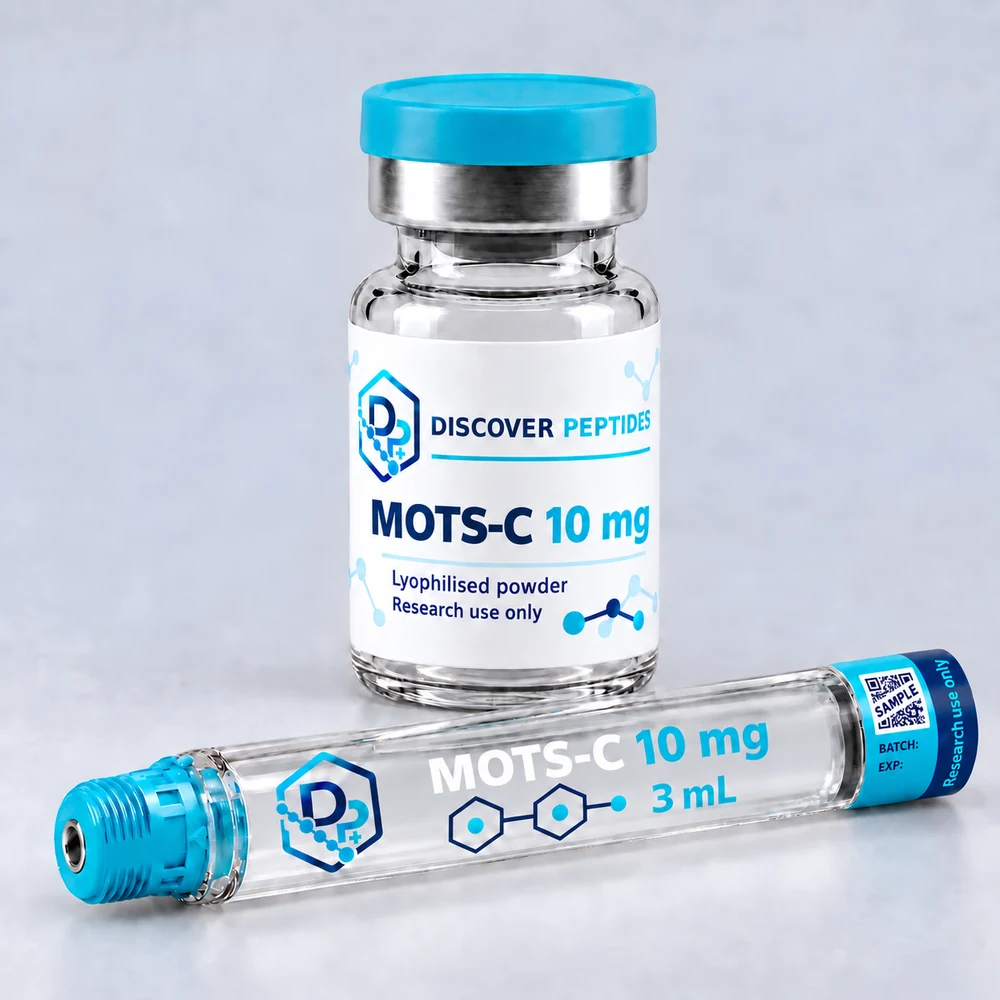
MOTS-c
An evidence-based, plain-language information page on this mitochondrial-derived peptide, metabolic and exercise research, major uncertainties, anti-doping status and South African context.
Contents
What MOTS-c is
Important information and disclaimer
Researched uses
Potential future uses
How it works
What evidence has found
South African regulatory context
How it compares
Risks and uncertainties
Treatment and measurement safeguards
Common questions
Join for updates
Sources
Important information and disclaimer
This page is for general education. MOTS-c is an investigational research peptide and is not an approved treatment for diabetes, obesity, ageing, fatigue, muscle loss, athletic performance or any other condition. This page does not diagnose metabolic disease, recommend treatment, replace professional care, or provide personal injection or dosing instructions.
A vial labelled ‘MOTS-c’, ‘mitochondrial peptide’, ‘research grade’ or with a CAS number does not establish human-medicine quality. Exact sequence, terminal chemistry, peptide content, purity, sterility, formulation, stability and storage history may be unknown.
MOTS-c is explicitly prohibited at all times for athletes under the 2026 World Anti-Doping Agency Prohibited List. People with abnormal glucose, unexplained weakness or suspected mitochondrial disease need medical assessment rather than experimental self-treatment. Severe allergic symptoms, collapse or acute metabolic deterioration requires urgent care.
What is MOTS-c?
MOTS-c stands for mitochondrial open reading frame of the 12S rRNA-c. It is a 16-amino-acid mitochondrial-derived peptide encoded within the mitochondrial 12S ribosomal RNA region using the standard genetic code. It is proposed to act as a stress-responsive signal between mitochondria, the cytoplasm and the nucleus.
Identity distinctions that prevent confusion
What is MOTS-c researched for?
Most MOTS-c research has examined cellular signalling and animal models. The original 2015 work reported effects on metabolic homeostasis, diet-induced obesity and insulin resistance in mice. Later studies explored exercise response, skeletal-muscle function, inflammation and age-related physical decline.
Glucose handling and insulin sensitivity
Energy sensing and metabolic flexibility
Exercise adaptation and skeletal-muscle function
Stress resistance and inflammatory signalling
Age-related physical decline in preclinical models
Associations between circulating MOTS-c and human metabolic states
These are research questions, not approved indications. Endogenous blood concentrations or observational associations cannot show that injected synthetic MOTS-c improves disease, physical performance or lifespan.
Other potential uses—only if future research confirms them
Potential clinical development areas include prediabetes, insulin resistance, obesity, sarcopenia, mitochondrial dysfunction and selected age-related diseases. A newly registered study, NCT07505745, plans to evaluate MOTS-c for insulin sensitivity in adults with prediabetes and overweight or obesity. Registration of a trial is not evidence that the treatment works.
Claims involving longevity, “anti-ageing”, fat loss, bodybuilding, recovery, brain protection or immune enhancement remain unconfirmed. A related analogue, CB4211, has entered metabolic-disease research, but results from an analogue cannot be attributed directly to native MOTS-c.
How does MOTS-c work?
Energy sensing through AMPK
MOTS-c is reported to influence folate and purine metabolism, increasing the AMP-related metabolite AICAR and activating AMP-activated protein kinase (AMPK). AMPK helps cells respond to low-energy states by shifting fuel use and regulating glucose and lipid metabolism.
Mitochondria-to-nucleus signalling
Under metabolic or exercise stress, MOTS-c may translocate to the nucleus and interact with stress-response pathways and antioxidant-response elements. This makes it an example of retrograde signalling: mitochondria influencing nuclear gene expression rather than acting only as power-producing organelles.
Muscle mechanisms
Recent preclinical work suggests direct binding to and activation of casein kinase 2, with downstream effects on skeletal-muscle function. Such mechanistic discoveries are valuable but do not establish a safe dose, useful clinical effect or long-term risk profile in humans.
What has evidence found?
Foundational animal evidence
The discovery study found that synthetic MOTS-c improved glucose homeostasis and reduced diet-induced obesity and insulin resistance in mice. A later mouse study reported improved physical capacity in young, middle-aged and older animals. These findings justify research but cannot predict the human benefit-risk balance.
Human evidence is mainly observational
Human studies have measured circulating or muscle MOTS-c in relation to exercise, ageing and metabolic conditions. Concentrations may vary with age, tissue, assay, exercise timing and disease. Association does not show that administering the peptide will reproduce a beneficial natural response.
No established therapeutic trial result
As of the review date, no completed, adequately powered randomised trial has established that native MOTS-c treats prediabetes, obesity, sarcopenia or ageing in humans. The new ClinicalTrials.gov study is a research milestone, but results are not yet available.
Anti-doping status
WADA lists MOTS-c under S4.4.1 metabolic modulators as an AMPK activator. It is prohibited at all times, in and out of competition. “Natural”, “endogenous” or “research-only” descriptions do not remove an athlete’s strict-liability risk.
Evidence and regulatory position in 2026
Current South African context
SAHPRA’s 2026 peptide-products warning states that unregistered peptide products promoted for human use have not been evaluated locally for quality, safety or efficacy. A review of publicly accessible SAHPRA resources did not identify a registered MOTS-c medicine or South African professional information.
This does not prove that no approved clinical-trial activity or future application exists. Current status should be checked directly with SAHPRA. South African competitive athletes are also subject to anti-doping rules through the applicable sporting bodies and should treat MOTS-c as prohibited.
How MOTS-c compares with metabolic approaches
Known risks, contraindications and uncertainties
MOTS-c has no approved product label and therefore no regulator-established human adverse-event profile. Short research exposure cannot define risks from repeated, high-dose, combined or long-term use.
Possible peptide-product risks include hypersensitivity, injection-site reactions, contamination, infection, endotoxin and incorrect concentration.
AMPK and metabolic signalling can affect glucose and energy balance; interactions with diabetes medicines and fasting are unknown.
Potential effects on pregnancy, development, fertility and breastfeeding are not established.
Long-term effects on tumour biology, cardiovascular function, immune signalling and organ-specific metabolism are uncertain.
Different assays and poorly characterised material make online claims and laboratory comparisons unreliable.
Competitive athletes face a clear anti-doping prohibition independent of claimed medical or research purpose.
Treatment and measurement safeguards
This page deliberately does not give a dose, mixing instruction, syringe-unit conversion, cycling schedule or performance protocol. Published preclinical quantities cannot be converted into a safe human regimen, and a future clinical protocol cannot be copied outside its ethics, manufacturing and monitoring controls.
People concerned about insulin resistance, fatigue or reduced performance should use validated assessment such as glucose or HbA1c, medicine review, sleep and nutritional evaluation, cardiovascular assessment and, where indicated, specialist testing for neuromuscular or mitochondrial disease.
Common questions
Is MOTS-c an approved anti-ageing medicine?
No. It has no approved anti-ageing or longevity indication.
Has it been proven to improve insulin sensitivity in humans?
No therapeutic benefit has yet been established; a newly registered human study is designed to investigate this question.
Is MOTS-c the same as SS-31?
No. SS-31 is elamipretide, a different tetrapeptide with different biology and regulatory status.
Does exercise naturally increase MOTS-c?
Some studies report exercise-related changes, but findings depend on tissue, assay and timing and do not validate injection.
Can a tested athlete use it?
No. The 2026 WADA Prohibited List explicitly includes MOTS-c as an AMPK activator prohibited at all times.
Does a CAS number prove authenticity?
No. It does not prove sequence, peptide content, purity, sterility, stability or medicine quality.
Is it registered in South Africa?
No public SAHPRA registration was identified in this review; verify directly because regulatory records can change.
Join for research and regulatory updates
Join the future research bulletin for first human trial results, safety findings, anti-doping changes and South African regulatory updates. Subscription does not provide medical advice, product supply, athletic-use clearance or dosing instructions.
Consent wording for the future form: “I agree to receive evidence and regulatory updates by email. This service does not provide medical advice, personal dosing instructions or product supply.”
Sources and further reading
SAHPRA. Warning About Unregistered Peptide Products: What You Need to Know and How To Stay Safe. Published 2026; accessed 7 September 2026.
World Anti-Doping Agency. 2026 Prohibited List, section S4.4.1: AMPK activators, including MOTS-c.
Lee C, et al. The mitochondrial-derived peptide MOTS-c promotes metabolic homeostasis and reduces obesity and insulin resistance. Cell Metabolism. 2015;21:443-454. PMID 25738459.
Reynolds JC, et al. MOTS-c is an exercise-induced mitochondrial-encoded regulator of age-dependent physical decline and muscle homeostasis. Nature Communications. 2021.
Wang Y, et al. MOTS-c modulates skeletal muscle function by directly binding and activating CK2. 2024. PMID 39559755.
ClinicalTrials.gov. NCT07505745: MOTS-c for improving insulin sensitivity in adults with prediabetes and overweight/obesity.
ClinicalTrials.gov. NCT02304211: CB4211 clinical development record; a related analogue, not native MOTS-c.
PubChem. MOTS-c human compound record, CID 155885767.
Editorial method: regulator and anti-doping documents, registered trials and peer-reviewed primary studies were prioritised. Animal findings, human associations and therapeutic evidence were kept separate. Review after major trial or regulatory changes, and no later than March 2027.


Reviews
There are no reviews yet.