POPULAR 2026 | RESEARCH LIBRARY
Plecanatide
An evidence-based, plain-language information page on this locally acting oral peptide medicine for chronic constipation and IBS-C, with South African context.
Contents
What plecanatide is
Important information and disclaimer
Approved and researched uses
Potential future uses
How it works
What evidence has found
Current regulatory and South African status
How it compares
Risks and uncertainties
Use and product safeguards
Common questions
Join for updates
Sources
Important information and disclaimer
This page is for general education. Plecanatide is a prescription medicine in the United States and must be used for an appropriate diagnosis under professional care. Constipation, abdominal pain and bloating can have many causes, including obstruction and other conditions requiring different or urgent care. This page does not diagnose a bowel disorder, recommend treatment or replace approved product information.
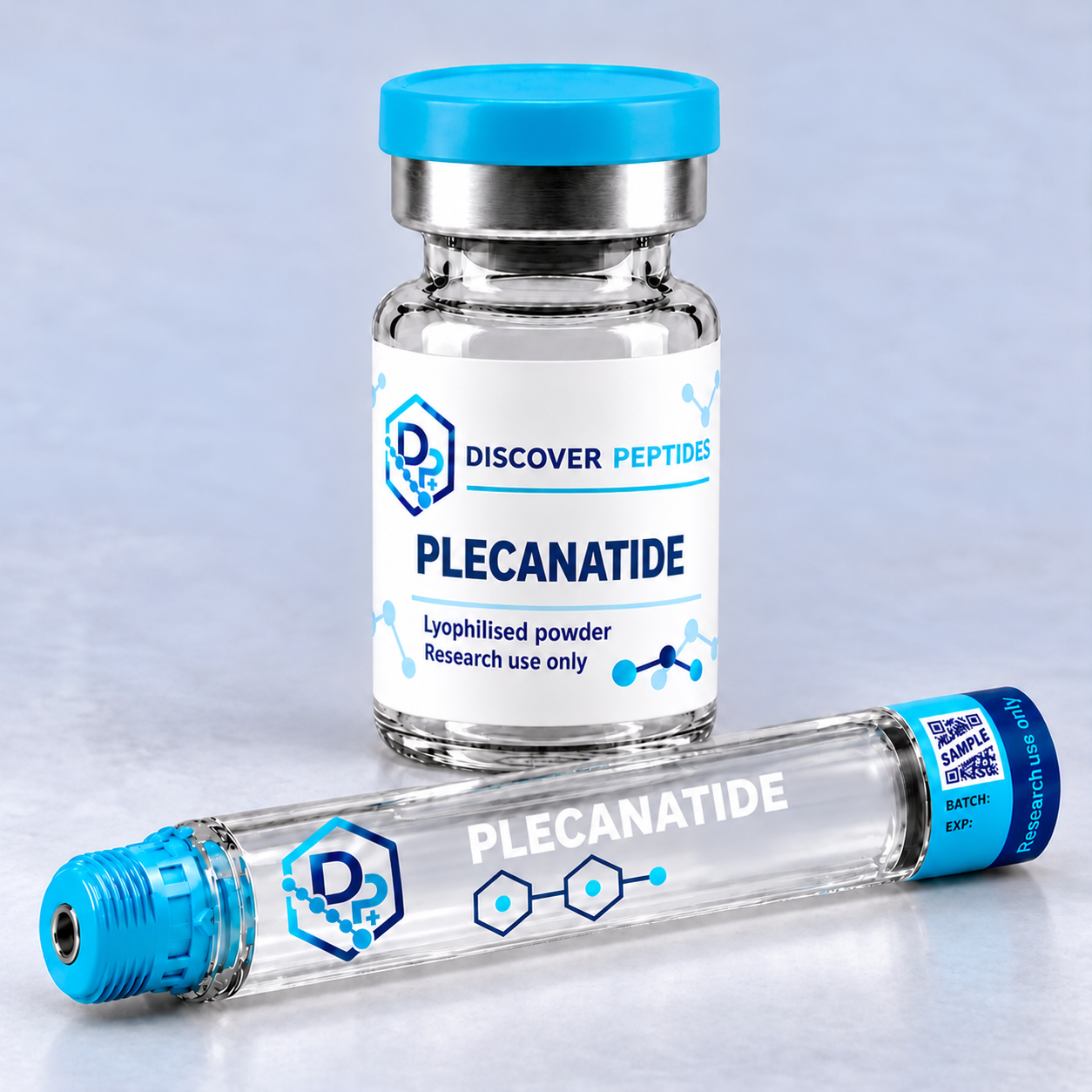
A tablet, capsule, powder or raw material labelled ‘plecanatide’, ‘Trulance’, ‘uroguanylin analogue’ or ‘research grade’ is not thereby equivalent to an authorised medicine. Identity, sequence, peptide content, purity, formulation, stability and manufacturing controls may be unknown. The TRULANCE name applies to a specific finished tablet, not unrelated bulk material.
Severe or persistent diarrhoea, marked thirst, fainting, confusion, very low urine output, blood in stool, severe abdominal swelling, repeated vomiting, fever with abdominal pain or symptoms suggesting bowel obstruction require prompt medical assessment.
What is plecanatide?
Plecanatide is a synthetic 16-amino-acid peptide structurally related to the human intestinal peptide uroguanylin. It activates guanylate cyclase-C (GC-C) receptors on the luminal surface of the intestinal epithelium. The authorised medicine is swallowed as a tablet and acts mainly inside the gastrointestinal tract, with negligible systemic absorption.
Identity distinctions that prevent confusion
What is plecanatide approved or researched for?
TRULANCE is authorised by the US Food and Drug Administration for two adult conditions: chronic idiopathic constipation (CIC) and irritable bowel syndrome with constipation (IBS-C). Its safety and effectiveness have not been established in patients younger than 18 years.
Adult CIC, defined by persistent constipation without an identified structural or metabolic cause
Adult IBS-C, where recurrent abdominal pain occurs with constipation and altered bowel habits
Improvement of complete spontaneous bowel movements and related constipation symptoms
Improvement of abdominal-pain and stool outcomes in a subset of adults with IBS-C
Plecanatide is not an ordinary wellness supplement, detoxification aid or weight-loss medicine. A proper diagnosis matters because constipation may result from obstruction, medicines, pelvic-floor dysfunction, neurological or endocrine disease, or other gastrointestinal pathology.
Other potential uses—only if future research confirms them
Research into GC-C signalling may clarify whether plecanatide or related molecules have value in additional functional bowel disorders, visceral-pain phenotypes or carefully defined patient subgroups. Future studies may also identify predictors of response and the best sequence with dietary, behavioural and other pharmaceutical approaches.
Mechanistic interest in epithelial signalling, intestinal barrier biology or inflammation does not establish an authorised use for inflammatory bowel disease, cancer prevention, microbiome modification or general gut health.
How does plecanatide work?
Uroguanylin-like signalling
Plecanatide binds GC-C receptors on the intestinal surface. Its activity is influenced by the mildly acidic environment of the proximal small intestine, resembling the pH-sensitive behaviour of uroguanylin. This biochemical feature distinguishes it from linaclotide but does not make the two medicines interchangeable.
Fluid secretion and transit
GC-C activation increases intracellular cyclic guanosine monophosphate (cGMP). This activates the CFTR ion channel and increases chloride and bicarbonate secretion into the intestinal lumen. Water follows, softening stool and accelerating transit.
Pain signalling and local action
Higher extracellular cGMP has been associated with reduced activity of pain-sensing visceral nerves in animal models. Plecanatide and its active metabolite are minimally absorbed and are broken down in the gastrointestinal tract. Low systemic exposure does not remove the risk of severe local fluid loss and dehydration.
What has evidence found?
Chronic idiopathic constipation trials
Two 12-week randomised, placebo-controlled studies enrolled adults meeting modified Rome III CIC criteria. Plecanatide improved durable overall complete spontaneous bowel-movement response and several secondary symptoms, including stool consistency and straining, compared with placebo. The clinical trial definition is more specific than occasional constipation.
IBS-C trials
Two 12-week randomised trials in adults with IBS-C evaluated combined abdominal-pain and complete spontaneous bowel-movement response. Plecanatide produced statistically significant improvement over placebo, but only a subset met the combined responder endpoint. This is symptom management, not a cure for IBS-C.
Safety experience
Across the controlled programmes, diarrhoea was the most common adverse reaction. Current US information reports severe diarrhoea in approximately 0.6% of treated patients in the CIC trials and roughly 1% in the IBS-C trials. Severe cases may begin early and require treatment interruption and rehydration.
Evidence and regulatory position in 2026
Current regulatory and South African status
Plecanatide is an established prescription medicine in the United States. TRULANCE received FDA approval for adult CIC in January 2017 and for adult IBS-C in January 2018. The current US label remains adult-only and carries a boxed warning about serious dehydration in paediatric patients.
Plecanatide does not have a centrally authorised European Union product identified through the EMA medicine register. This differs from linaclotide, marketed as CONSTELLA in the EU for adult IBS-C.
The September 2026 review found no publicly identifiable plecanatide or TRULANCE professional-information entry in SAHPRA’s online PI/PIL repository. Absence from the public repository is not conclusive proof that no registration, older record, section 21 authorisation or lawful access route exists. The website should not claim routine South African registration or availability without verification for the exact finished product.
Foreign approval does not authorise South African importation, compounding, promotion, dispensing or sale. Raw peptide is not equivalent to the authorised US tablet and should not be positioned as such.
How plecanatide compares with other constipation medicines
Known risks, contraindications and uncertainties
Diarrhoea is the main adverse effect and may become severe. Less common reported effects include abdominal distension, gas, abdominal tenderness, nausea, dizziness, vomiting, rash, itching or hives. Persistent diarrhoea can cause dehydration and electrolyte disturbance.
Contraindicated in children younger than six because juvenile-animal deaths occurred from dehydration.
Avoid use from age six to under 18; safety and effectiveness have not been established in paediatric patients.
Contraindicated in known or suspected mechanical gastrointestinal obstruction.
If severe diarrhoea occurs, authorised information advises suspending treatment and rehydrating the patient.
New bleeding, weight loss, anaemia, persistent vomiting, fever or night symptoms should not simply be labelled IBS.
Systemic exposure is negligible, but pregnancy and breastfeeding decisions still require professional assessment.
Use and product safeguards
This page deliberately does not provide a personal regimen or instructions for making tablets from raw peptide. The authorised tablet’s identity, excipients, strength, stability and manufacturing controls are part of the evidence package.
Plecanatide is designed for oral, local intestinal action. Injection, nasal or sublingual use would be unstudied, would defeat the authorised delivery concept and could introduce serious sterility and systemic-exposure risks.
Response and adverse effects should be reviewed. Continuing a medicine that gives no meaningful benefit, or persisting through severe diarrhoea, is not supported simply because the product is classified as locally acting.
Common questions
Is plecanatide really a peptide?
Yes. It is a synthetic 16-amino-acid peptide related to human uroguanylin. The authorised medicine is an oral tablet, not an injection.
Is it the same as linaclotide?
No. Both activate GC-C, but their sequences, pH responsiveness, products, authorised indications and paediatric provisions differ.
Does it cure constipation or IBS-C?
No. It can improve bowel and pain outcomes in some adults, but it does not correct every underlying cause and does not cure IBS-C.
Can children use it?
The US label is adult-only, contraindicates use below age six and advises avoiding it from six to under 18.
Can it be used for weight loss?
No authorised indication supports weight loss. Weight change caused by diarrhoea or dehydration is not healthy fat loss.
Is it registered in South Africa?
No public plecanatide entry was identified in SAHPRA’s online PI/PIL repository during this review. The exact product status must be confirmed directly.
Does a raw-material certificate make it TRULANCE-equivalent?
No. It does not establish the authorised tablet formulation, strength, stability, manufacturing controls or regulatory approval.
Join for research and regulatory updates
Join the future research bulletin for important label changes, safety communications, paediatric research and South African registration or availability updates. Subscription does not provide medical advice, prescribing, product supply or personal dosing instructions.
Consent wording for the future form: “I agree to receive evidence and regulatory updates by email. This service does not provide medical advice, personal dosing instructions or product supply.”
Sources and further reading
US National Library of Medicine DailyMed. TRULANCE (plecanatide) prescribing information; revised March 2024, reviewed 7 September 2026.
US Food and Drug Administration. NDA 208745 approval letter for TRULANCE in adult chronic idiopathic constipation, 19 January 2017.
Miner PB Jr, et al. Plecanatide in chronic idiopathic constipation: two randomised clinical trials.
Brenner DM, et al. Efficacy and safety of plecanatide in irritable bowel syndrome with constipation: phase 3 randomised trials.
ClinicalTrials.gov. NCT01722318 and NCT02387359, plecanatide IBS-C studies.
SAHPRA. Repository of Professional Information and Patient Information Leaflets, searched for plecanatide and TRULANCE on 7 September 2026.
Editorial method: regulator information and pivotal randomised evidence were prioritised over commercial pages. South African status is stated cautiously because absence from a public repository is not conclusive proof of non-registration. Review after major label or registration changes, and no later than March 2027.


Reviews
There are no reviews yet.