

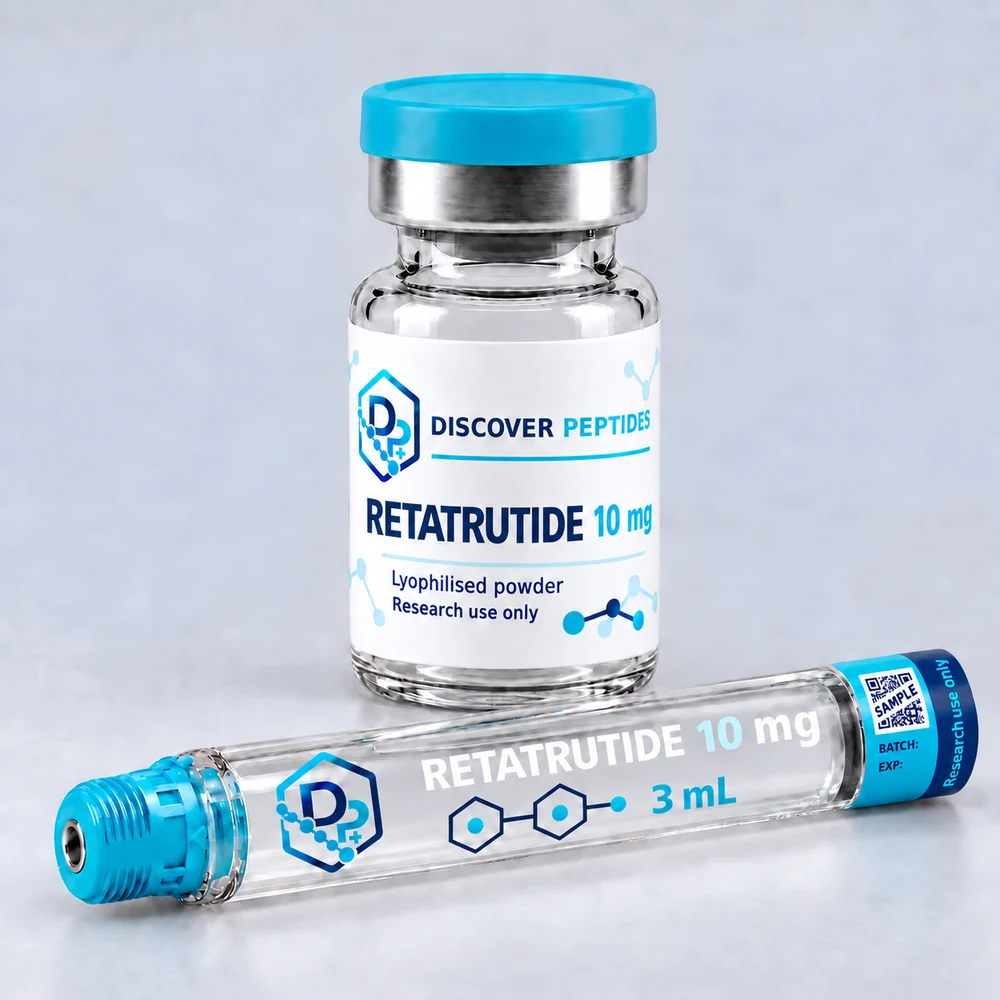
Retatrutide
R1,245.00 – R1,790.00Price range: R1,245.00 through R1,790.00
An evidence-based, plain-language research page covering identity, mechanism, current evidence, safety, dosing uncertainty and regulatory status.
Please note, to maintain the quality and integrity of every product, all orders are fulfilled on a made-to-order basis. Please allow 7–14 days for processing and delivery. You will receive tracking details as soon as your order is dispatched.
Research Use Only.
This product is supplied strictly for research use. It is not intended for human consumption, administration, therapeutic use, diagnosis, or veterinary use. Customers are responsible for ensuring that their purchase and use of research products comply with applicable laws, regulations, and institutional requirements.
- Research Focused
- Clear Specifications
- Transparent Pricing
- South African Supply
POPULAR 2026 | RESEARCH LIBRARY
Retatrutide
An evidence-based, plain-language research page covering identity, mechanism, current evidence, safety, dosing uncertainty and regulatory status.
Contents
What retatrutide is
Researched for
Potential future uses
How it works
What research has found
Latest 2026 evidence
How it compares
Current status
Risks and uncertainties
Dosing and measurement uncertainty
Common questions
Join for updates
Sources
Important information and disclaimer
This page is for general education and discussion of published research. It does not advertise, offer or recommend retatrutide; it does not replace advice from a qualified healthcare professional; and it must not be used to diagnose, treat or prevent any condition.
Retatrutide remains investigational. A vial or product offered online under the name “retatrutide,” “Reta” or “Triple G” is not thereby proven to contain the pharmaceutical substance used in a regulated clinical trial. Its identity, purity, strength, sterility, stability and storage history may be unknown. “Research use only” wording does not establish quality or make self-administration safe or lawful.
If someone has used an unknown product and becomes unwell, they should seek professional medical assistance. Severe or persistent abdominal pain, repeated vomiting, inability to keep fluids down, symptoms of dehydration, breathing difficulty, facial or throat swelling, fainting, confusion or severe hypoglycaemia require urgent assessment.
What is retatrutide?
Retatrutide is a laboratory-designed, long-acting peptide being developed by Eli Lilly. It is a single molecule intended to activate receptors for three naturally occurring metabolic signals: glucose-dependent insulinotropic polypeptide (GIP), glucagon-like peptide-1 (GLP-1) and glucagon. This three-receptor design explains the informal description triple agonist.
Retatrutide is not tirzepatide or semaglutide
What is retatrutide being researched for?
The retatrutide clinical programme is examining whether its combined receptor activity can produce meaningful metabolic effects while maintaining an acceptable safety and tolerability profile.
Obesity and overweight • Type 2 diabetes • Knee osteoarthritis with obesity • Obstructive sleep apnoea • Fatty liver disease • Cardiovascular and kidney outcomes • Chronic low-back pain with obesity
These labels describe research questions, not approved uses. A positive result for body weight does not automatically prove a reduction in heart attacks, kidney failure, disability or long-term mortality. Trials designed around those outcomes are needed.
Other potential uses—if future research confirms them
Researchers are interested in whether changes in weight, glucose regulation, liver fat and cardiometabolic markers might eventually translate into broader clinical benefits. Possible future applications discussed within formal development programmes include metabolic dysfunction-associated steatotic liver disease, obstructive sleep apnoea, cardiovascular risk and obesity-associated pain or mobility limitations.
These possibilities should be presented cautiously. Weight loss can improve several risk factors, but a plausible mechanism or favourable laboratory marker is not the same as proof that retatrutide prevents a specific disease or improves survival.
How might retatrutide work?
GLP-1 receptor activity
GLP-1 signalling can increase glucose-dependent insulin release, reduce glucagon secretion when glucose is elevated, slow stomach emptying and influence appetite pathways. The degree and duration of each effect can change during treatment.
GIP receptor activity
GIP is another nutrient-responsive hormone involved in insulin secretion and energy regulation. Researchers are studying how combined GIP and GLP-1 activity may alter metabolic responses compared with activating GLP-1 alone.
Glucagon receptor activity
Glucagon signalling can increase hepatic glucose output and energy expenditure. This creates both scientific interest and complexity: activation might support energy use, while also requiring the molecule’s overall balance across all three receptors to be understood carefully.
Retatrutide’s effects cannot be predicted by simply adding together the effects of three separate medicines. Receptor potency, duration, tissue exposure, dose escalation and individual biology all influence the final response.
What has research found so far?
Peer-reviewed Phase 2 obesity trial
A randomised Phase 2 trial involving adults with obesity or overweight evaluated retatrutide over 48 weeks. The study reported dose-related weight reduction, with mean reductions reaching approximately 24% in a higher-dose group under the trial’s efficacy analysis. Gastrointestinal adverse events were common, particularly during dose escalation. Phase 2 results can identify promising signals and help select regimens, but they do not settle long-term benefit and risk.
Phase 3 obesity results reported in 2026
In May 2026, Lilly announced topline results from TRIUMPH-1, a randomised Phase 3 trial enrolling 2,339 adults with obesity or overweight and at least one weight-related condition, without diabetes. At 80 weeks, the company reported mean weight changes of 19.0%, 25.9% and 28.3% in the 4 mg, 9 mg and 12 mg groups respectively under the efficacy estimand, compared with 2.2% for placebo. A prespecified extension in a selected subgroup with a baseline BMI of at least 35 reported continued mean weight reduction through 104 weeks.
These are company-reported topline findings. Detailed peer-reviewed publication and full regulatory review remain important because summaries do not provide every analysis, subgroup result or safety detail.
Phase 3 type 2 diabetes results reported in 2026
In March 2026, Lilly reported that TRANSCEND-T2D-1 met its primary and key secondary endpoints. Across the tested target-dose groups, mean HbA1c reductions were reported at approximately 1.7 to 2.0 percentage points at 40 weeks under the efficacy estimand. Mean body-weight reduction reached 16.8% in the 12 mg group. A fuller peer-reviewed account was subsequently published in The Lancet in June 2026 and is summarised in the latest-evidence section below.
How strong is the evidence?
Latest 2026 evidence update
Retatrutide moved into a more mature evidence phase during 2026. One Phase 3 type 2 diabetes trial was published in a peer-reviewed journal, while the developer announced topline findings from three large Phase 3 obesity trials. “Topline” means that selected main results have been released before all analyses have necessarily appeared in a complete peer-reviewed paper.
Evidence timeline
Phase 3 trial comparison
Results from different trials should not be ranked as though they were a direct competition. Participants, baseline risks, duration, endpoints, statistical estimands and treatment conditions differed. A head-to-head trial is the sounder way to compare medicines.
What the cardiovascular findings do not prove
TRIUMPH-3 reported exploratory cardiovascular-event analyses with wide confidence intervals. The reported hazard ratios did not establish a statistically conclusive reduction in major cardiovascular events. Improvements in weight, blood pressure, triglycerides or inflammation markers are encouraging risk-factor findings, but they are not substitutes for a dedicated cardiovascular-outcomes conclusion.
How retatrutide compares with related medicines
It is tempting to compare the largest percentage reported in one trial with a number from another medicine’s trial. That is an indirect comparison and can mislead. Differences in participant characteristics, study duration, adherence assumptions and statistical methods may change the apparent result.
Retatrutide should therefore not be called “stronger Ozempic,” “generic Mounjaro,” or a proven replacement for either medicine. Those phrases conceal important molecular, evidentiary and regulatory differences.
Current development and regulatory status
Status on 5 September 2026: investigational. Retatrutide is in Phase 3 development and does not have routine marketing authorisation. Positive trial results do not themselves create an approved medicine.
A US pre-approval expanded-access study appears in the ClinicalTrials.gov registry. Expanded access is a controlled regulatory pathway for certain eligible patients; it is not general commercial availability and does not validate products sold online. Eligibility, participating locations and status must be confirmed through the official registry and treating specialists.
Possible regulatory timeline
In July 2026, Lilly stated that it planned to submit a US Biologics License Application in the first quarter of 2027. Plans can change, and a submission can be delayed, refused for filing, reviewed over an extended period or ultimately not approved. A US application would also not automatically grant South African registration.
Availability and cost
There is no authorised retail retatrutide price to compare while the medicine remains investigational. Prices attached to online vials describe unverified commercial products, not an official price for an approved medicine. No responsible availability forecast should be presented as certain until the relevant regulator acts and the manufacturer announces a launch.
This page found no basis to present retatrutide as a SAHPRA-registered medicine. Regulatory databases and official notices should be checked again immediately before any future commercial decision. South African rules distinguish publishing general information from manufacturing, importing, advertising or distributing an unregistered medicine.
A May 2026 SAHPRA and South African Pharmacy Council notice concerned unlawful manufacture and distribution of unregistered GLP-1/GIP products containing semaglutide, tirzepatide or their combination. It did not name retatrutide, but its concerns about unverified active ingredients, inadequate analytical testing, sterility and promotion illustrate why an investigational online vial cannot be equated with a regulated clinical-trial medicine.
Known risks, uncertainties and evidence gaps
Across trials, the most frequently reported adverse events have been gastrointestinal, including nausea, diarrhoea, constipation and vomiting. In the 2026 TRIUMPH-1 topline release, these events generally became more frequent at higher target doses. Altered skin sensations, described as dysaesthesia, were also reported, as were treatment discontinuations caused by adverse events.
Other concerns require continued study or clinical caution, including dehydration following persistent gastrointestinal symptoms, gallbladder disease, pancreatitis, changes in blood glucose, interactions with diabetes treatment, delayed stomach emptying, nutritional inadequacy during rapid weight loss, lean-mass changes, and risks around anaesthesia or deep sedation. It is not yet possible to characterise every uncommon or long-term risk.
Pregnancy, breastfeeding, childhood and adolescence, severe gastrointestinal disease, previous pancreatitis, significant kidney or liver illness, endocrine tumour syndromes and combinations with other metabolic medicines require specific evidence and professional assessment. Absence of a warning here must not be interpreted as evidence of safety.
Selected Phase 3 tolerability findings
These percentages belong to monitored clinical trials using controlled investigational material. They cannot predict the risk of a vial obtained from an unidentified or unregulated source, where contamination, substitution or concentration error may introduce entirely different hazards.
Nutrition, muscle and rapid weight change
Large changes in appetite and body weight raise questions beyond the number on a scale. Future and ongoing research should clarify body-composition changes, maintenance of muscle and function, nutritional adequacy, bone health, treatment duration and what happens after discontinuation. These issues may be especially important in older adults or people already vulnerable to frailty or muscle loss.
Dosing: why this page does not provide instructions
This educational page does not provide a retatrutide dose, titration schedule, cycle, reconstitution volume or injection conversion. Clinical-trial schedules are research protocols for screened participants using controlled material and monitoring; copying a number from a trial does not make an unknown product equivalent or its use safe.
Online dosing discussions are especially confusing because they may mix milligrams, millilitres, “units,” syringe markings, vial totals and concentrations. A statement such as “ten units” has no independent meaning unless the syringe specification and verified concentration are both known. The same vial size can contain very different amounts, and adding the same liquid volume does not produce the same concentration across products.
Additional uncertainty includes the exact molecular form, actual peptide content, manufacturing impurities, sterility, degradation, storage, route, indication, dose-escalation protocol, other medicines and the individual’s medical risks. No calculator can correct for an incorrectly identified or unverified substance.
Future dosing information: subscribers may receive updates about published dose-ranging studies, regulatory decisions, standardised medication identity, concentration labelling and safer measurement systems. Subscription does not provide personal dosing advice or early access to an investigational medicine.
Common questions
Is retatrutide the same as Mounjaro or Zepbound?
No. Those brands contain tirzepatide, a dual GIP/GLP-1 receptor agonist. Retatrutide is a different investigational molecule designed to activate GIP, GLP-1 and glucagon receptors.
Is retatrutide approved because Phase 3 results were positive?
No. Phase 3 results may support an application, but regulators must review the complete evidence, manufacturing controls, labelling and benefit-risk balance before granting marketing authorisation.
Does “research grade” mean pharmaceutical grade?
No. “Research grade” is not proof of suitability for human administration. A label alone does not verify identity, purity, potency, sterility, stability or manufacturing quality.
Can retatrutide be called a GLP-1?
It has GLP-1 receptor activity, but calling it only “a GLP-1” hides its GIP and glucagon receptor activity. “Investigational GIP/GLP-1/glucagon triple receptor agonist” is more precise.
How quickly did retatrutide work in trials?
Trials measured changes over many months, commonly 40 or 80 weeks, and some participants continued longer. The published curves and reports describe gradual average change under protocol conditions, not a guaranteed personal timetable.
Does retatrutide have an official price?
No authorised retail price exists while retatrutide remains investigational. Online vial prices should not be interpreted as an official medicine price.
When will retatrutide be approved?
There is no confirmed approval date. The developer has announced an intended US submission in early 2027, but submission, regulatory review, approval, South African registration and commercial launch are separate events.
Can someone enrol in a retatrutide study?
Study participation depends on the official protocol, recruitment status, location and individual eligibility. The ClinicalTrials.gov record or another recognised national registry should be consulted, followed by discussion with an appropriate healthcare professional. This website does not recruit or refer participants.
Will weight return after stopping?
The long-term pattern after discontinuing retatrutide is not yet fully defined. Experience with chronic obesity therapies makes maintenance an important research question, but results from a different medicine should not simply be assigned to retatrutide.
Join for research updates
Join the future research bulletin for significant trial publications, regulatory decisions, safety communications, terminology corrections and progress toward clearer medication identity and measurement standards.
Consent wording for the future form: “I agree to receive evidence and regulatory updates by email. This service does not provide medical advice, personal dosing instructions or product offers. I can unsubscribe at any time.” The live website should add a privacy notice explaining who controls the information, why it is collected, how long it is retained and how a subscriber can exercise POPIA rights.
Sources and further reading
Jastreboff AM, et al. Triple-Hormone-Receptor Agonist Retatrutide for Obesity — A Phase 2 Trial. New England Journal of Medicine, 2023.
ClinicalTrials.gov. NCT05929066: TRIUMPH-1 Phase 3 study. Registry record accessed 5 September 2026.
ClinicalTrials.gov. NCT06354660: TRANSCEND-T2D-1 Phase 3 study. Registry record accessed 5 September 2026.
Eli Lilly and Company. TRIUMPH-1 Phase 3 topline results, 21 May 2026. Company release; detailed peer review was pending at the review date.
Eli Lilly and Company. TRANSCEND-T2D-1 Phase 3 topline results, 19 March 2026. Historical company release followed by the June 2026 peer-reviewed publication.
Bajaj HS, et al. TRANSCEND-T2D-1: randomised Phase 3 trial. The Lancet, 2026;407:2402-2413. DOI: 10.1016/S0140-6736(26)00967-0.
Eli Lilly and Company. TRIUMPH-2 and TRIUMPH-3 Phase 3 topline results, 23 July 2026. Company release; detailed peer-reviewed reports were pending at the review date.
ClinicalTrials.gov. NCT05929079: TRIUMPH-2. Registry record accessed 5 September 2026.
ClinicalTrials.gov. NCT05882045: TRIUMPH-3. Registry record accessed 5 September 2026.
ClinicalTrials.gov. NCT07629401: pre-approval expanded access. Registry record accessed 5 September 2026.
U.S. National Library of Medicine, PubChem. Retatrutide compound record. Accessed 5 September 2026.
SAHPRA and SAPC. Notice concerning unlawful manufacture and distribution of unregistered GLP-1/GIP medicines, 23 May 2026.
World Health Organization. Statement on safe and appropriate use of GLP-1 receptor agonists, 30 July 2026.
Editorial method: trial and regulatory sources were prioritised over commercial pages. Quantitative claims identify whether they come from peer-reviewed research or company-reported topline results. This subject should be reviewed when a major trial is published, a regulator makes a decision, or no later than 5 March 2027.
| Quantity | 10 mg, 20 mg |
|---|
Lyophilized: Stable at −20°C for up to 24 months when kept dry and protected from light.
Reconstituted: Store at 2–8°C. Use within 28 days. Do not freeze after reconstitution.
Diluent: Bacteriostatic water (BW) recommended for multi-dose use. See Protocols.
Research Use Only.
This product is supplied strictly for research use. It is not intended for human consumption, administration, therapeutic use, diagnosis, or veterinary use. Customers are responsible for ensuring that their purchase and use of research products comply with applicable laws, regulations, and institutional requirements.
You may also research
Related Compounds
Reviews
There are no reviews yet.