POPULAR 2026 | RESEARCH LIBRARY
Setmelanotide
An evidence-based, plain-language information page on targeted melanocortin-4 receptor treatment for specific rare genetic and hypothalamic forms of obesity.
Contents
What setmelanotide is
Important information and disclaimer
Approved and researched uses
Potential future uses
How it works
What evidence has found
Current regulatory and South African status
How it compares
Risks and uncertainties
Diagnosis and product safeguards
Common questions
Join for updates
Sources
Important information and disclaimer
This page is for general education. Setmelanotide is a highly specialised prescription medicine for narrowly defined rare causes of obesity. It is not a treatment for ordinary or polygenic obesity and must not be selected solely from body weight, appetite or appearance. Diagnosis, genetic interpretation and ongoing monitoring require an experienced multidisciplinary team.
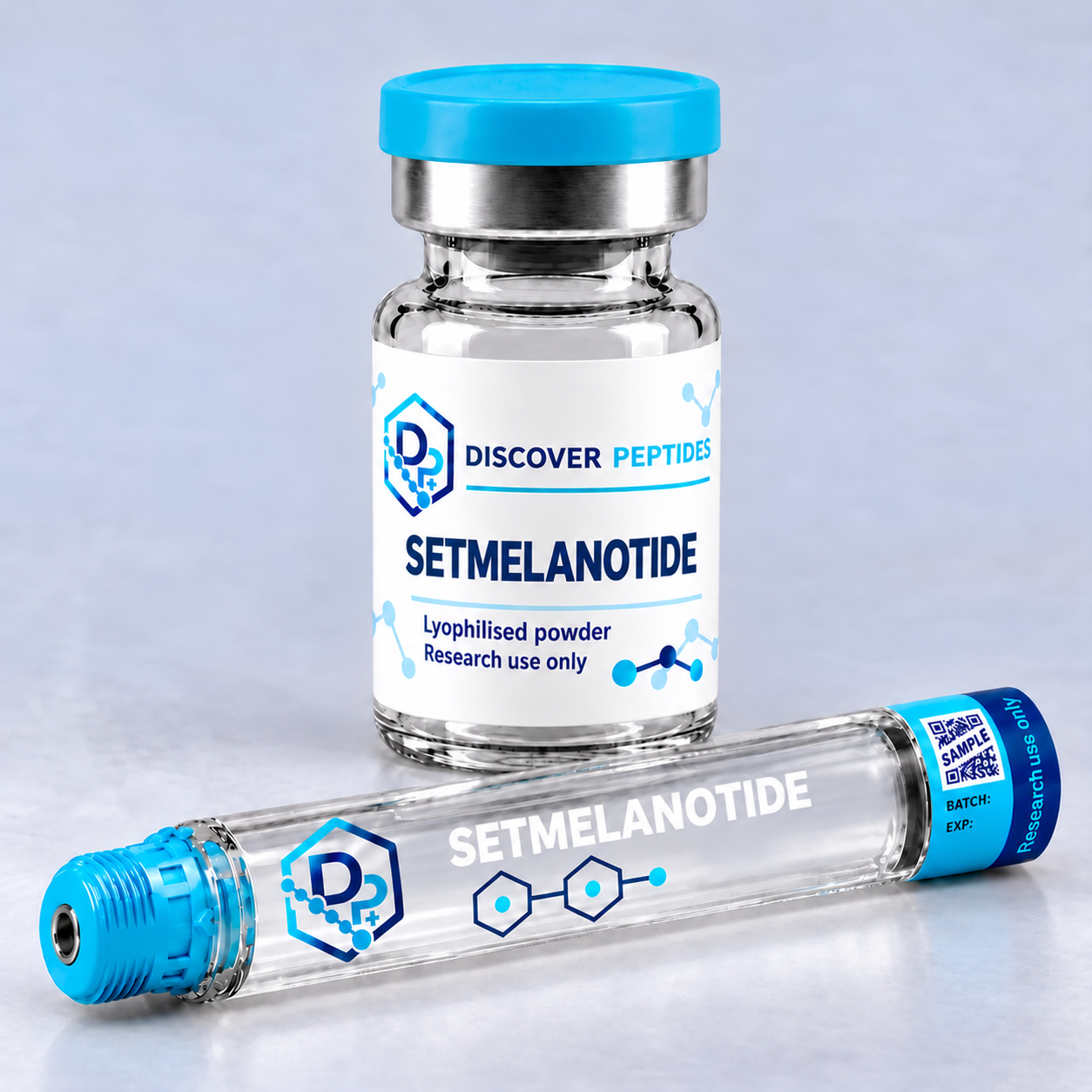
A vial or powder labelled ‘setmelanotide’, ‘IMCIVREE’, ‘MC4R agonist’ or ‘research grade’ is not thereby equivalent to an authorised medicine. Identity, peptide content, purity, sterility, formulation, stability, concentration and cold-chain history may be unknown. The IMCIVREE name applies to a specific authorised finished product.
New suicidal thoughts, severe depression, anaphylaxis, collapse, a prolonged erection lasting more than four hours, severe vomiting or diarrhoea, or symptoms of acute adrenal or sodium disturbance require urgent medical assessment.
What is setmelanotide?
Setmelanotide is a synthetic cyclic peptide and selective melanocortin-4 receptor (MC4R) agonist. MC4R sits downstream of the leptin-melanocortin pathway in the hypothalamus, a brain network involved in hunger, satiety and energy balance. The medicine can restore signalling when certain upstream defects leave the MC4R pathway functionally under-stimulated.
Identity distinctions that prevent confusion
What is setmelanotide approved or researched for?
The current US label, updated in 2026, authorises IMCIVREE to reduce excess body weight and maintain weight reduction long term in specific groups: acquired hypothalamic obesity from age four; Bardet-Biedl syndrome from age two; and POMC, PCSK1 or LEPR deficiency from age two when genetic testing demonstrates a pathogenic, likely pathogenic or contextually relevant variant of uncertain significance.
Pro-opiomelanocortin (POMC) deficiency obesity
Proprotein convertase subtilisin/kexin type 1 (PCSK1) deficiency obesity
Leptin receptor (LEPR) deficiency obesity
Bardet-Biedl syndrome (BBS)
Acquired hypothalamic obesity (HO), added to the US indication in March 2026
It is specifically not indicated for general polygenic obesity, for unrelated genetic obesity syndromes, or for suspected POMC/PCSK1/LEPR deficiency where variants are classified as benign or likely benign. The pathway defect must match the medicine’s mechanism.
Other potential uses—only if future research confirms them
Research continues in additional rare syndromic obesity disorders and in conditions where hypothalamic injury disrupts melanocortin signalling. Future studies may refine which forms of hypothalamic obesity respond, which genetic variants are functionally important, and how response differs by age and underlying disease.
A result in one rare pathway disorder cannot be extrapolated to common obesity, cosmetic weight loss, metabolic syndrome or appetite control in otherwise healthy people. Each additional syndrome requires evidence that the signalling defect remains responsive at MC4R.
How does setmelanotide work?
The leptin-melanocortin pathway
Signals from fat stores and the gut reach hypothalamic neurons. Leptin normally promotes POMC processing through PCSK1, producing melanocortin peptides that activate MC4R. Activation reduces hunger and supports energy expenditure. Defects in POMC, PCSK1 or LEPR can leave MC4R insufficiently stimulated even when the receptor itself is intact.
Bypassing an upstream block
Setmelanotide directly activates MC4R and can therefore bypass selected upstream defects. In responsive patients, hunger may decrease and sustained weight loss may follow. It is not a replacement for absent MC4R function and does not address every biological cause of obesity.
Why pigmentation and sexual effects occur
Melanocortin receptors also influence pigmentation and sexual physiology. Setmelanotide’s receptor activity can cause generalised skin darkening, changes in existing moles, new melanocytic naevi and spontaneous sexual arousal effects. These are mechanism-related effects, not incidental cosmetic outcomes.
What has evidence found?
POMC, PCSK1 and LEPR deficiency trials
Open-label pivotal studies in very small genetically defined populations found clinically meaningful weight loss and reductions in hunger in many participants. The rarity of these disorders makes conventional large trials difficult. Evidence is persuasive for the matched pathway defects but the samples are small and do not support use in common obesity.
Bardet-Biedl syndrome
A randomised placebo-controlled phase followed by open-label treatment supported weight reduction in patients with BBS. Response varied, and BBS involves many medical issues beyond weight, including visual, renal, endocrine and developmental complications that still require specialist care.
Acquired hypothalamic obesity
The 2026 US expansion followed clinical evidence in people with hypothalamic injury-associated obesity, a condition that can occur after tumours, surgery or radiotherapy. The label includes age four and older. These patients may also have pituitary hormone deficiencies, diabetes insipidus and adrenal vulnerability requiring separate monitoring.
Evidence and regulatory position in 2026
Current regulatory and South African status
IMCIVREE received initial US approval in 2020. Its US indication expanded over time to BBS, younger paediatric patients and, in March 2026, acquired hypothalamic obesity from age four. The European Union also authorises IMCIVREE for defined rare genetic obesity conditions, but the exact eligible disorders and age thresholds must be checked in the current European product information.
The September 2026 review found no publicly identifiable setmelanotide or IMCIVREE professional-information entry in SAHPRA’s online PI/PIL repository. This is not conclusive proof that no registration, older record, section 21 authorisation or named-patient access route exists. Routine South African registration or availability should not be claimed without verification for the exact finished product.
Because eligible disorders are exceptionally rare, any lawful South African access would likely require coordination among specialist endocrinology, clinical genetics, the product holder, a lawful importer and funder. Foreign approval does not itself authorise South African importation, promotion, dispensing or sale.
How setmelanotide compares with other obesity medicines
Known risks, contraindications and uncertainties
Common adverse reactions include skin hyperpigmentation, injection-site reactions, nausea, headache, diarrhoea, abdominal pain, vomiting, depression and spontaneous penile erections. The safety profile differs by indication, age and underlying disease.
Depression and suicidal ideation have occurred; new or worsening symptoms require active monitoring and prompt action.
Spontaneous erections and sexual adverse effects may occur. An erection lasting longer than four hours is a medical emergency.
Generalised hyperpigmentation, darkening of existing moles and new naevi require a full skin examination before treatment and periodically thereafter.
Serious hypersensitivity, including anaphylaxis, has been reported and is a contraindication after a prior serious reaction.
For acquired hypothalamic obesity, the 2026 label adds monitoring for acute adrenal insufficiency and sodium imbalance, especially with central diabetes insipidus.
Use is not recommended in end-stage renal disease; severe renal impairment changes eligibility or product instructions.
Breastfeeding is not recommended under the US label. Pregnancy decisions require specialist assessment.
Diagnosis and product safeguards
This page deliberately does not provide personal dosing, titration, injection technique or vial calculations. Authorised regimens vary by indication, age, body weight, tolerability and kidney function. Reproducing a dose from raw peptide bypasses the diagnostic and product controls central to safe use.
POMC, PCSK1 and LEPR variants require expert interpretation. A variant of uncertain significance is not automatically causative; it must be judged in the clinical context. A general consumer DNA report is not equivalent to diagnostic genetic testing and counselling.
Monitoring may include weight trajectory, hunger, growth and development, mood, skin examination, sexual adverse effects, renal function and indication-specific endocrine risks. In acquired hypothalamic obesity, pituitary, adrenal and sodium disorders may be more immediately dangerous than weight itself.
Common questions
Is setmelanotide another GLP-1 medicine?
No. It activates MC4R in the hypothalamic melanocortin pathway and is intended for narrowly defined rare causes of obesity.
Can anyone with obesity use it?
No. The US label specifically excludes general polygenic obesity and unrelated genetic obesity syndromes.
Does a DNA result prove eligibility?
Not by itself. POMC, PCSK1 and LEPR results require expert classification and correlation with the clinical phenotype.
Why can it darken the skin?
Melanocortin signalling also affects pigment cells, so hyperpigmentation and mole changes are mechanism-related effects.
Is it the same as Melanotan II?
No. Melanotan II is a different, non-selective and unapproved melanocortin analogue.
Is it registered in South Africa?
No public entry was identified in SAHPRA’s online PI/PIL repository during this review. The exact registration or named-patient access position must be confirmed.
Is acquired hypothalamic obesity now included?
Yes in the US label from March 2026 for adults and children aged four and older who meet the clinical criteria.
Join for research and regulatory updates
Join the future research bulletin for new rare-disease indications, genetic-selection guidance, safety communications and South African access updates. Subscription does not provide medical advice, genetic interpretation, prescribing, product supply or dosing instructions.
Consent wording for the future form: “I agree to receive evidence and regulatory updates by email. This service does not provide medical advice, personal dosing instructions or product supply.”
Sources and further reading
US National Library of Medicine DailyMed. IMCIVREE (setmelanotide) prescribing information, updated 1 April 2026.
US Food and Drug Administration. IMCIVREE label, NDA 213793, revision 2026.
US Food and Drug Administration. Approval of setmelanotide for weight management in Bardet-Biedl syndrome, 2022.
European Medicines Agency. IMCIVREE (setmelanotide) EPAR and current product information.
Clément K, et al. Setmelanotide in POMC or LEPR deficiency obesity: phase 3 trials. Lancet Diabetes & Endocrinology. 2020.
Haqq AM, et al. Setmelanotide in Bardet-Biedl syndrome: randomised phase 3 trial. Lancet Diabetes & Endocrinology. 2022.
SAHPRA. Repository of Professional Information and Patient Information Leaflets, searched for setmelanotide and IMCIVREE on 7 September 2026.
Editorial method: current regulator information and pivotal clinical evidence were prioritised over commercial pages. The April 2026 US label is important because it added acquired hypothalamic obesity and indication-specific warnings. Review after major label or registration changes, and no later than March 2027.

Reviews
There are no reviews yet.