POPULAR 2026 | RESEARCH LIBRARY
Survodutide
An evidence-based, plain-language research page covering its dual GLP-1/glucagon design, obesity and MASH programmes, current evidence, safety and regulatory status.
Contents
What survodutide is
Important information and disclaimer
Researched for
Potential future uses
How it works
What research has found
Latest 2026 evidence
How it compares
Current status
Risks and uncertainties
Dosing and measurement uncertainty
Common questions
Join for updates
Sources
Important information and disclaimer
This page is for general education and discussion of published research. It does not advertise, offer, prescribe or recommend survodutide; it does not replace advice from a qualified healthcare professional and does not provide personal dosing, reconstitution or injection instructions.
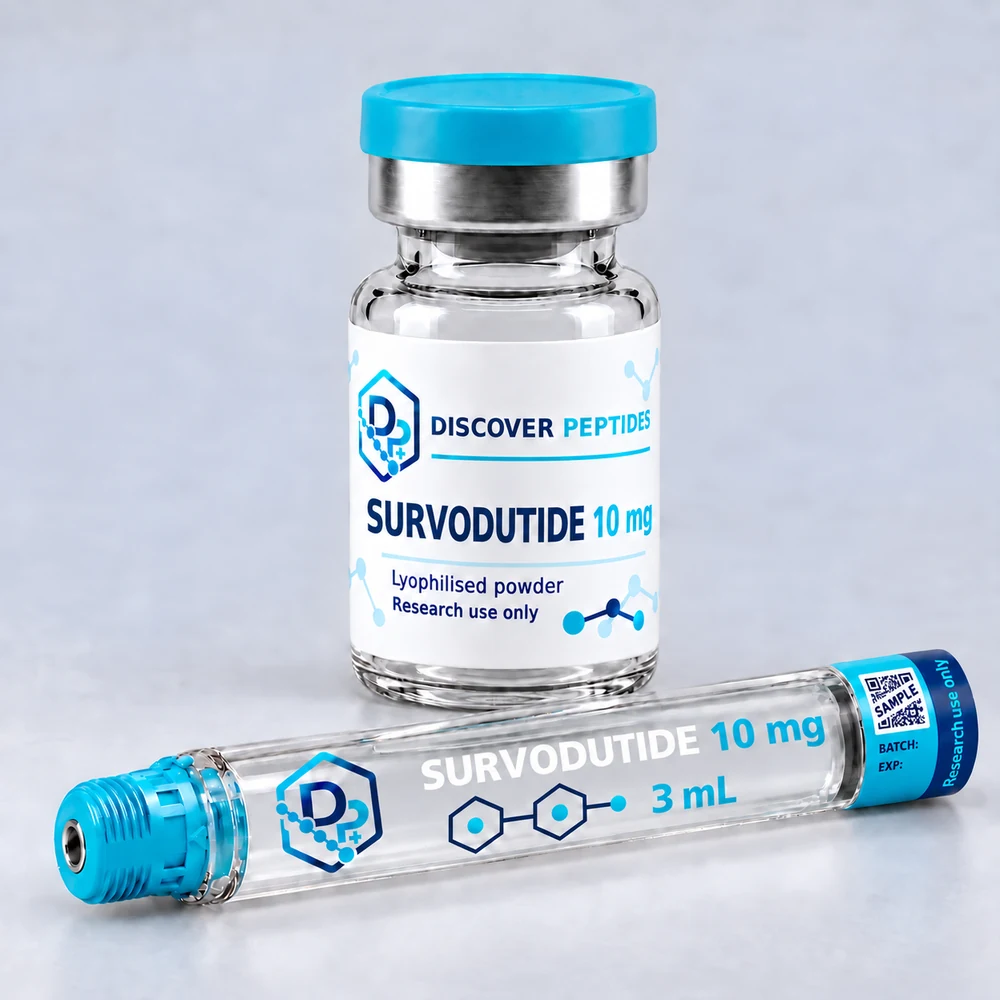
Survodutide remains investigational. A vial sold online as ‘survodutide’, ‘BI 456906’ or another informal name is not thereby proven to contain the pharmaceutical substance used in regulated trials. Identity, purity, strength, sterility, stability, formulation and storage history may be unknown.
If someone has used an unknown product and becomes unwell, professional medical assistance is appropriate. Persistent vomiting, inability to keep fluids down, severe abdominal pain, confusion, collapse, breathing difficulty, jaundice or severe weakness requires urgent assessment.
What is survodutide?
Survodutide is a laboratory-designed, long-acting peptide co-developed by Boehringer Ingelheim and Zealand Pharma. It is a single molecule intended to activate both the glucagon-like peptide-1 (GLP-1) receptor and the glucagon receptor. This dual design is being studied for obesity and metabolic dysfunction-associated steatohepatitis (MASH), a progressive form of fatty liver disease.
Survodutide is not semaglutide, tirzepatide or retatrutide
What is survodutide being researched for?
The clinical programme is testing whether balanced GLP-1 and glucagon receptor activity can reduce body weight and harmful fat deposits while improving metabolic and liver-related outcomes with acceptable safety and tolerability.
Obesity and overweight • Obesity with type 2 diabetes • MASH with moderate or advanced fibrosis • MASH-related cirrhosis • Visceral fat and liver fat • Body composition and cardiometabolic risk markers
These are research questions, not approved indications. Changes in weight, liver enzymes, imaging or biopsy endpoints do not automatically prove prevention of cirrhosis, liver failure, cardiovascular events or death.
Other potential uses—if future research confirms them
Researchers may eventually clarify whether survodutide benefits selected people with MASLD before advanced MASH, obesity-related metabolic complications or high visceral-fat burden. Evidence would need to define the population, stage of liver disease, duration, monitoring and long-term clinical outcomes.
The liver programme is scientifically important because glucagon-receptor activity may influence hepatic fat handling and energy expenditure. This remains a hypothesis requiring confirmation in prospective trials; post-hoc mediation analysis cannot by itself prove a direct liver-protective mechanism.
How might survodutide work?
GLP-1 receptor activity
GLP-1 signalling can reduce appetite, slow gastric emptying and support glucose-dependent insulin secretion. These effects may reduce energy intake and improve some metabolic measures.
Glucagon receptor activity
Glucagon signalling can increase hepatic glucose output and may increase energy expenditure and affect liver-fat metabolism. This creates both therapeutic interest and complexity because excessive glucagon activity could oppose glucose control.
The balance matters
Survodutide is engineered so the two activities occur in one molecule. Its overall response depends on relative receptor potency, exposure, escalation, baseline diabetes and liver status. It should not be described as simply ‘semaglutide plus glucagon’.
What has research found so far?
Phase 2 obesity trial
A randomised, double-blind Phase 2 trial in adults with overweight or obesity reported dose-related weight reduction over 46 weeks. Higher-dose groups showed substantial average reductions, while gastrointestinal adverse events and treatment discontinuation increased at some doses. Phase 2 findings established a signal and informed Phase 3, but did not settle long-term benefit and risk.
Phase 2 MASH trial
A 48-week randomised Phase 2 trial in biopsy-confirmed MASH reported higher proportions of MASH improvement without worsening fibrosis with survodutide than placebo. Fibrosis improvement and non-invasive liver measures were also explored. Histology endpoints are clinically meaningful development markers, but long-term outcomes such as decompensation, transplantation and survival require longer study.
2026 mediation analysis
A 2026 post-hoc analysis of 170 participants with F2-F3 fibrosis estimated how much of the observed liver effect might be mediated by weight reduction. More of the steatosis-related effect appeared weight-linked, while less than half of several inflammation/fibrosis effects was estimated to be mediated by weight loss. The authors described this as suggestive of a possible direct glucagon-receptor role; it is not definitive causal proof.
2026 Phase 3 body-composition findings
Boehringer Ingelheim reported Phase 3 findings describing reductions in visceral fat and liver fat with relative preservation of lean mass. These company-reported analyses are relevant to healthy-ageing and metabolic research, but full methods, comparator context, prespecified status and peer-reviewed reporting determine how strongly they should be interpreted.
Latest 2026 evidence update
How survodutide compares with related medicines
Survodutide is differentiated by the attempt to address obesity and progressive metabolic liver disease through one dual GLP-1/glucagon molecule. That does not establish superiority over approved obesity medicines or over other MASH therapies. Direct comparisons and outcome trials are required.
Current development and regulatory status
Status on 7 September 2026: investigational. Survodutide is in Phase 3 development for obesity and MASH and does not have routine marketing authorisation for those indications. Trial registration, breakthrough designations or positive findings do not equal product approval.
This review found no basis to present survodutide as a SAHPRA-registered medicine. A future US, European or other regulatory filing would not automatically grant South African registration. SAHPRA databases and official notices should be rechecked immediately before publication and after any major regulatory milestone.
South African law distinguishes neutral health education from manufacturing, importing, advertising, prescribing or distributing an unregistered medicine. This information page is designed for the educational side of that boundary and should not be paired with purchase prompts or implied treatment promises.
Known risks, uncertainties and evidence gaps
The most frequently reported adverse effects in clinical research have been gastrointestinal, including nausea, vomiting and diarrhoea. Appetite suppression and persistent gastrointestinal symptoms can contribute to dehydration, nutritional inadequacy and treatment discontinuation.
Glucagon-receptor activity adds glucose and liver-metabolism questions that cannot be inferred from GLP-1 medicines alone.
Gallbladder disease, pancreatitis signals, heart-rate changes and severe gastrointestinal symptoms require continued product-specific evaluation.
Rapid weight loss raises questions about lean mass, strength, nutrition and bone health, particularly in older or frail adults.
Advanced liver disease is medically complex; results in one fibrosis stage should not be extrapolated to decompensated cirrhosis.
Pregnancy, breastfeeding, childhood use and combinations with insulin or other metabolic medicines require specific evidence and clinical supervision.
Trial safety data describe screened participants using controlled investigational material. They cannot predict the risk of an unidentified online vial, where incorrect identity, strength, impurities, degradation or non-sterility may create different hazards.
Dosing: why this page does not provide instructions
This page does not provide a dose, escalation schedule, cycle, reconstitution volume or syringe-unit conversion. Trial regimens were research protocols for selected participants using controlled formulations, predefined stopping rules and monitoring.
Online discussion can confuse milligrams, millilitres and syringe ‘units’. A syringe marking represents volume, not peptide mass. The same vial size can contain different amounts, and no calculator can correct for an incorrectly identified or unverified substance.
Common questions
Is survodutide the same as retatrutide?
No. Survodutide targets GLP-1 and glucagon receptors; retatrutide also targets GIP and is a different molecule.
Is it approved because it is in Phase 3?
No. Phase 3 is late-stage research. Regulators must still review efficacy, safety, manufacturing and proposed labelling.
Does the MASH study prove it prevents cirrhosis?
No. Histology and biomarker improvements are important, but prevention of liver failure, transplantation or death requires longer outcome evidence.
Does less liver fat mean fibrosis is cured?
No. Steatosis, inflammation and fibrosis are related but distinct. Imaging and enzymes cannot be treated as interchangeable with biopsy or clinical outcomes.
Does research grade mean pharmaceutical grade?
No. The term does not prove identity, purity, potency, sterility, stability or suitability for human administration.
When will it be available in South Africa?
There is no confirmed date. Global development, regulatory submissions, approval, SAHPRA registration and commercial launch are separate steps.
Join for research updates
Join the future research bulletin for major trial publications, regulatory decisions, safety communications, terminology corrections and South African status changes. Subscription does not provide medical advice, product access or dosing instructions.
Consent wording for the future form: “I agree to receive evidence and regulatory updates by email. This service does not provide medical advice, personal dosing instructions or product supply.”
Sources and further reading
ClinicalTrials.gov. NCT06066515: SYNCHRONIZE-1 Phase 3 obesity study. Reviewed 7 September 2026.
ClinicalTrials.gov. NCT06066528: SYNCHRONIZE-2 Phase 3 obesity and type 2 diabetes study. Reviewed 7 September 2026.
ClinicalTrials.gov. NCT06632444: LIVERAGE Phase 3 MASH study. Reviewed 7 September 2026.
ClinicalTrials.gov. NCT06632457: LIVERAGE-Cirrhosis Phase 3 study. Reviewed 7 September 2026.
ClinicalTrials.gov. NCT04771273: Survodutide Phase 2 MASH study.
le Roux CW, et al. Glucagon and GLP-1 receptor dual agonist survodutide for obesity: randomised Phase 2 trial. The Lancet Diabetes & Endocrinology, 2024.
Sanyal AJ, et al. Survodutide in MASH and fibrosis: randomised Phase 2 trial report, 2024.
Noureddin M, et al. Weight reduction-dependent/-independent effects of survodutide on liver endpoints. Hepatology, 2026. DOI: 10.1097/HEP.0000000000001825.
Boehringer Ingelheim. 2026 sponsor communications on SYNCHRONIZE Phase 3 body-composition, visceral-fat and liver-fat findings.
SAHPRA. Registered-health-products databases and applicable communications; status reviewed 7 September 2026.
Editorial method: trial registries, peer-reviewed reports, regulators and sponsor disclosures were prioritised over commercial pages. Sponsor-reported and post-hoc findings are labelled as such. Review after any Phase 3 publication, regulatory filing or decision, and no later than March 2027.


Reviews
There are no reviews yet.