

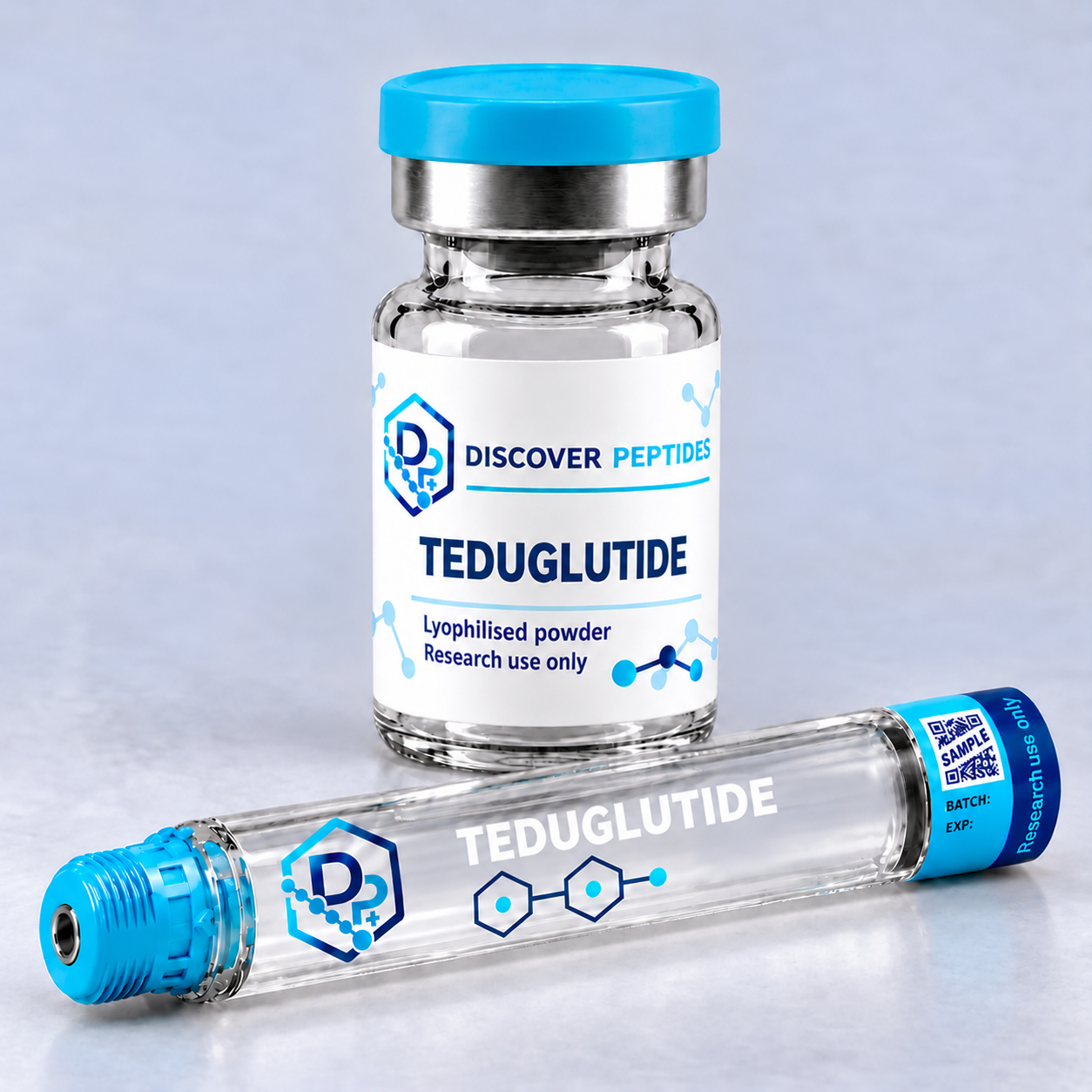
Teduglutide
R2,500.00
An evidence-based, plain-language information page on this GLP-2 analogue for short bowel syndrome with intestinal failure, including monitoring, safety and South African context.
Please note, to maintain the quality and integrity of every product, all orders are fulfilled on a made-to-order basis. Please allow 7–14 days for processing and delivery. You will receive tracking details as soon as your order is dispatched.
Research Use Only.
This product is supplied strictly for research use. It is not intended for human consumption, administration, therapeutic use, diagnosis, or veterinary use. Customers are responsible for ensuring that their purchase and use of research products comply with applicable laws, regulations, and institutional requirements.
- Research Focused
- Clear Specifications
- Transparent Pricing
- South African Supply
POPULAR 2026 | RESEARCH LIBRARY
Teduglutide
An evidence-based, plain-language information page on this GLP-2 analogue for short bowel syndrome with intestinal failure, including monitoring, safety and South African context.
Contents
What teduglutide is
Important information and disclaimer
Approved and researched uses
Potential future uses
How it works
What evidence has found
Current regulatory and South African status
How it compares
Risks and uncertainties
Treatment and product safeguards
Common questions
Join for updates
Sources
Important information and disclaimer
This page is for general education. Teduglutide is a specialised prescription medicine for selected people with short bowel syndrome who remain dependent on parenteral nutrition or intravenous fluids. It is not a general digestive, “gut-healing”, anti-ageing or weight-management peptide. Diagnosis, selection of treatment and adjustment of parenteral support require an experienced intestinal-failure team.
A vial or powder labelled ‘teduglutide’, ‘GATTEX’, ‘REVESTIVE’, ‘GLP-2’ or ‘research grade’ is not thereby equivalent to an authorised medicine. Identity, sequence, peptide content, purity, sterility, formulation, concentration, stability and cold-chain history may be unknown. GATTEX and REVESTIVE are names for specific regulated finished products.
Severe or increasing abdominal pain or swelling, repeated vomiting, no output from a stoma, jaundice, fever, breathing difficulty, rapid swelling or weight gain, fainting, confusion, blood in stool or signs of dehydration require prompt medical assessment. Treatment changes can alter fluid balance and absorption of other oral medicines.
What is teduglutide?
Teduglutide is a 33-amino-acid analogue of human glucagon-like peptide-2 (GLP-2). A single amino-acid substitution at position 2 makes it more resistant than natural GLP-2 to breakdown by dipeptidyl peptidase-4. It acts at GLP-2 receptors in the gastrointestinal tract and is designed to improve the absorptive capacity of the remaining bowel after major intestinal loss.
Identity distinctions that prevent confusion
What is teduglutide approved or researched for?
The current US label authorises GATTEX for adults and children aged one year and older with short bowel syndrome who are dependent on parenteral support. European product information authorises REVESTIVE for short bowel syndrome in patients aged four months corrected gestational age and older who are stable after a period of intestinal adaptation following surgery. Exact eligibility and age wording must always be checked against the local product information.
Short bowel syndrome with intestinal failure
Reduction of dependence on parenteral nutrition and/or intravenous fluids
Specialist adult and paediatric intestinal rehabilitation
Long-term support of intestinal adaptation where sufficient viable bowel remains
Teduglutide is not authorised simply because someone has diarrhoea, irritable bowel syndrome, inflammatory bowel disease, a stoma, malabsorption or previous bowel surgery. The approved population has a specific anatomy and continuing need for parenteral support.
Other potential uses—only if future research confirms them
Research and clinical discussion continue around timing of treatment, prediction of response, use in different bowel anatomies, long-term enteral autonomy, paediatric growth and whether selected forms of intestinal failure outside conventional short bowel syndrome could benefit. Related GLP-2 analogues are also being studied to improve convenience or durability of response.
These questions do not establish teduglutide as a treatment for Crohn’s disease, coeliac disease, “leaky gut”, ordinary diarrhoea, nutritional optimisation, bodybuilding or healthy ageing. An intestinotrophic mechanism can create clinically important risks and requires disease-specific evidence.
How does teduglutide work?
Replacing a short-lived intestinal signal
GLP-2 is released from intestinal L cells after food reaches the gut. It supports mucosal growth and maintenance, intestinal blood flow, barrier function and nutrient and fluid absorption. Natural GLP-2 is rapidly inactivated. Teduglutide’s position-2 substitution slows that breakdown and prolongs receptor stimulation.
Increasing absorptive capacity
GLP-2 receptor activation can increase villus height and crypt depth and can improve absorption of fluid and nutrients from the remaining intestine. As absorption improves, carefully supervised reductions in intravenous fluids or parenteral nutrition may become possible. The medicine does not regrow all missing bowel and does not guarantee freedom from parenteral support.
Why monitoring and support adjustment matter
A stronger absorptive response can change hydration, urine output, electrolyte needs and the exposure to medicines taken by mouth. Parenteral support must therefore be adjusted from clinical measurements rather than stopped abruptly. Sudden discontinuation of teduglutide can also disturb fluid and electrolyte balance.
What has evidence found?
Adult pivotal and extension studies
In the pivotal adult programme, more teduglutide-treated participants achieved a clinically meaningful reduction in weekly parenteral-support volume than placebo-treated participants. Longer extension data showed that reductions can deepen over time and that a minority of selected patients can attain enteral autonomy. Response varies substantially with anatomy, remaining colon, time since surgery and baseline support needs.
Paediatric evidence
Paediatric phase 3 studies found reductions in parenteral-support volume and time connected to infusions in many treated children. Some achieved enteral autonomy, but the studies were small because the condition is rare. Growth, nutrition, hydration and gastrointestinal surveillance remain central; treatment is not a substitute for paediatric intestinal rehabilitation.
What the evidence does not prove
Reduced parenteral support is a meaningful outcome because it can lessen catheter exposure and treatment burden, but it does not mean that every complication of intestinal failure disappears. Central-line infection risk, liver disease, renal problems, micronutrient deficiencies, stoma complications and underlying disease still require active care.
Evidence and regulatory position in 2026
Current regulatory and South African status
Teduglutide received initial US approval in 2012. The current GATTEX label covers adults and paediatric patients aged one year and older with short bowel syndrome who depend on parenteral support. REVESTIVE is authorised in the European Union for adults and children from four months corrected gestational age, subject to the detailed European criteria. Product names, presentations and paediatric thresholds are jurisdiction-specific.
The September 2026 review did not identify a publicly verifiable teduglutide, GATTEX or REVESTIVE professional-information entry in SAHPRA’s online PI/PIL repository. This absence is not conclusive proof that no registration, older record, section 21 authorisation or named-patient access route exists. South African status must be verified for the exact finished product before any claim of registration, importation, supply or promotion.
Because short bowel syndrome with intestinal failure is rare and complex, lawful access in South Africa would ordinarily involve a specialist intestinal-failure or gastroenterology service, nutrition support, pharmacy oversight, the product holder, a lawful importer and funding approval. Foreign authorisation does not itself permit South African sale or dispensing.
How teduglutide compares with related approaches
Known risks, contraindications and uncertainties
Common adverse reactions in the US label include abdominal pain, nausea, upper respiratory infection, abdominal distension, injection-site reactions, vomiting, fluid overload and hypersensitivity. The underlying illness and parenteral support can make attribution and monitoring complex.
Teduglutide can promote mucosal growth. Gastrointestinal polyps have occurred, and there is a potential risk of accelerating neoplastic growth. Required bowel surveillance must not be omitted.
If an active gastrointestinal malignancy develops, the US label directs discontinuation. For non-gastrointestinal malignancy, continuation requires an individual benefit–risk decision.
Intestinal or stomal obstruction has occurred. New abdominal pain, distension, vomiting or stopped stoma output requires urgent assessment and temporary treatment interruption may be necessary.
Gallbladder, biliary-tract and pancreatic disease, including cholelithiasis, cholecystitis, cholangitis and pancreatitis, require laboratory surveillance and further investigation when indicated.
Enhanced absorption can cause fluid overload and can worsen congestive heart failure. Parenteral support may need careful downward adjustment.
Stopping treatment may cause fluid and electrolyte imbalance; withdrawal should be monitored.
Absorption of concomitant oral medicines can increase. Narrow-therapeutic-index medicines and sedating medicines may require closer monitoring and adjustment.
Renal impairment changes exposure and authorised dosing. Pregnancy and breastfeeding decisions require specialist review of current local product information.
Treatment and product safeguards
This page deliberately omits personal dosing, reconstitution, injection technique and vial calculations. Authorised regimens are weight- and kidney-function dependent, and safe treatment requires simultaneous management of parenteral support. Raw peptide cannot reproduce the safeguards of a regulated kit, validated formulation, specialist monitoring and a verified cold chain.
Before and during treatment, the current US label specifies gastrointestinal screening, removal and surveillance of polyps, and laboratory assessment of bilirubin, alkaline phosphatase, lipase and amylase. Paediatric surveillance differs from adult surveillance. Exact intervals and procedures must follow the current jurisdiction-specific label and treating team.
Useful monitoring may include parenteral-support volume and calories, oral/enteral intake, urine and stoma output, weight, oedema, electrolytes, renal and liver function, micronutrients, catheter complications and the effect on concomitant oral medicines. “Less IV fluid” is not automatically safe if dehydration, kidney injury or electrolyte loss follows.
Common questions
Is teduglutide the same as GLP-1 weight-loss medicines?
No. Teduglutide activates GLP-2 receptors and is used for short bowel syndrome with intestinal failure, not diabetes or obesity.
Does it regrow a removed intestine?
No. It can improve the structure and absorptive function of remaining bowel, but it does not replace missing anatomy.
Can it eliminate parenteral nutrition?
Some selected patients achieve enteral autonomy, but many achieve only a partial reduction and some respond little.
Why are colonoscopy and other surveillance needed?
Its growth-promoting intestinal effect can be associated with polyps and creates concern about neoplastic growth.
Can it increase the effect of tablets?
Yes. Improved intestinal absorption may increase exposure to oral medicines, including medicines with narrow safety margins.
Is any “GLP-2 peptide” equivalent?
No. Sequence, formulation, sterility, strength and regulatory controls matter; related analogues are distinct products.
Is it registered in South Africa?
No public teduglutide entry was identified in SAHPRA’s online PI/PIL repository during this review. The exact registration or named-patient access position must be confirmed.
Join for research and regulatory updates
Join the future research bulletin for new intestinal-failure evidence, paediatric and long-term safety findings, GLP-2 analogue developments and South African regulatory updates. Subscription does not provide medical advice, prescribing, product supply, parenteral-support adjustment or dosing instructions.
Consent wording for the future form: “I agree to receive evidence and regulatory updates by email. This service does not provide medical advice, personal dosing instructions or product supply.”
Sources and further reading
US National Library of Medicine DailyMed. GATTEX (teduglutide) prescribing information, revised September 2025; accessed 7 September 2026.
US Food and Drug Administration. GATTEX (teduglutide), NDA 203441, current prescribing information.
European Medicines Agency. REVESTIVE (teduglutide) EPAR and current product information.
Jeppesen PB, et al. Teduglutide reduces need for parenteral support among patients with short bowel syndrome with intestinal failure. Gastroenterology. 2012.
Schwartz LK, et al. Long-term teduglutide for short bowel syndrome-associated intestinal failure: STEPS-2. Clinical and Translational Gastroenterology. 2016.
Kocoshis SA, et al. Safety and efficacy of teduglutide in paediatric patients with intestinal failure due to short bowel syndrome: a 24-week phase III study. JPEN. 2020.
Iyer KR, et al. Enteral autonomy and days off parenteral support with teduglutide treatment in the STEPS trials. JPEN. 2020.
SAHPRA. Repository of Professional Information and Patient Information Leaflets, searched for teduglutide, GATTEX and REVESTIVE on 7 September 2026.
Editorial method: current regulator information and pivotal or long-term clinical evidence were prioritised over commercial pages. Approved use, measured reduction of parenteral support and complete enteral autonomy were kept distinct. Review after major label or South African registration changes, and no later than March 2027.
Lyophilized: Stable at −20°C for up to 24 months when kept dry and protected from light.
Reconstituted: Store at 2–8°C. Use within 28 days. Do not freeze after reconstitution.
Diluent: Bacteriostatic water (BW) recommended for multi-dose use. See Protocols.
Research Use Only.
This product is supplied strictly for research use. It is not intended for human consumption, administration, therapeutic use, diagnosis, or veterinary use. Customers are responsible for ensuring that their purchase and use of research products comply with applicable laws, regulations, and institutional requirements.
You may also research
Related Compounds



Reviews
There are no reviews yet.