POPULAR 2026 | RESEARCH LIBRARY
Tesamorelin acetate
An evidence-based, plain-language information page on the stabilised GHRH analogue, its approved HIV-lipodystrophy use, emerging liver research, safety and South African context.
Contents
What tesamorelin acetate is
Important information and disclaimer
Approved and researched uses
Potential future uses
How it works
What evidence has found
South African regulatory context
How it compares
Risks and uncertainties
Treatment and measurement safeguards
Common questions
Join for updates
Sources
Important information and disclaimer
This page is for general education. Tesamorelin is a prescription medicine in jurisdictions where it is authorised and must be selected, prescribed and monitored by an appropriately qualified healthcare professional. It does not diagnose HIV-associated lipodystrophy, recommend treatment, replace the applicable professional information, or provide personal injection or dosing instructions.
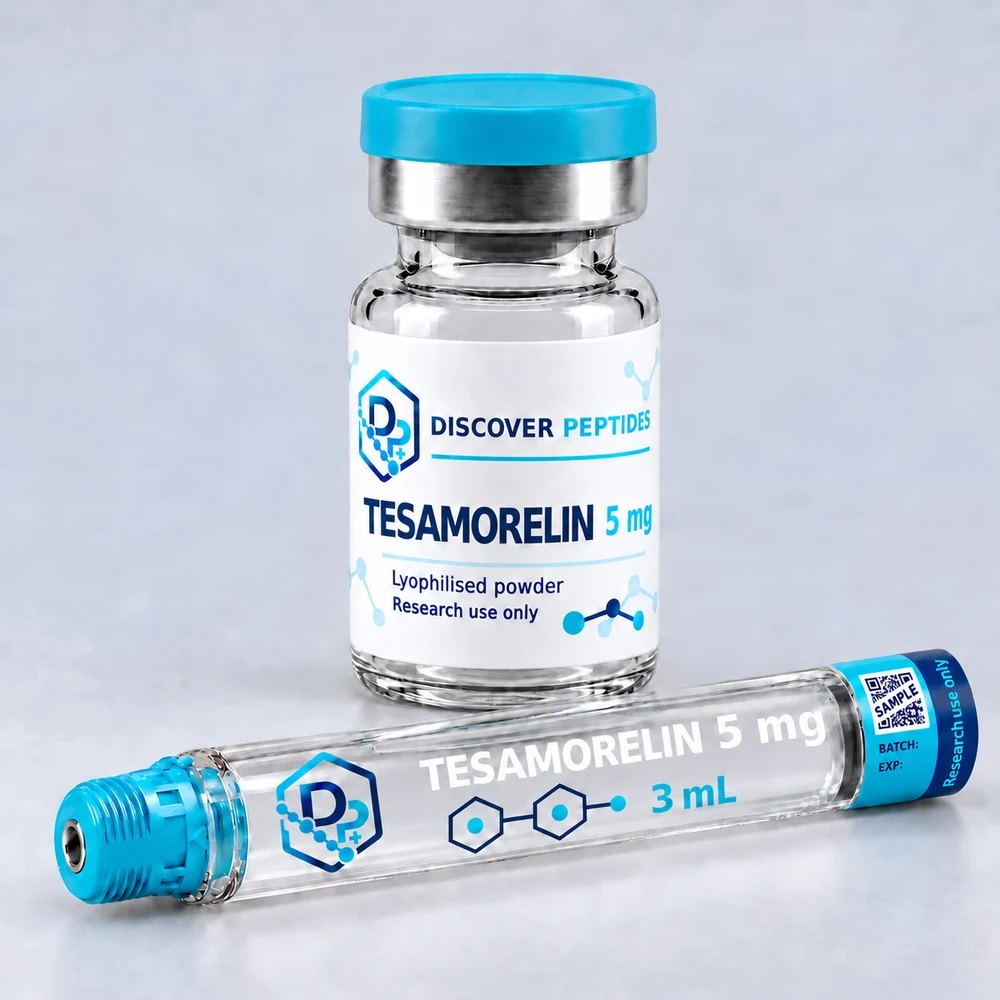
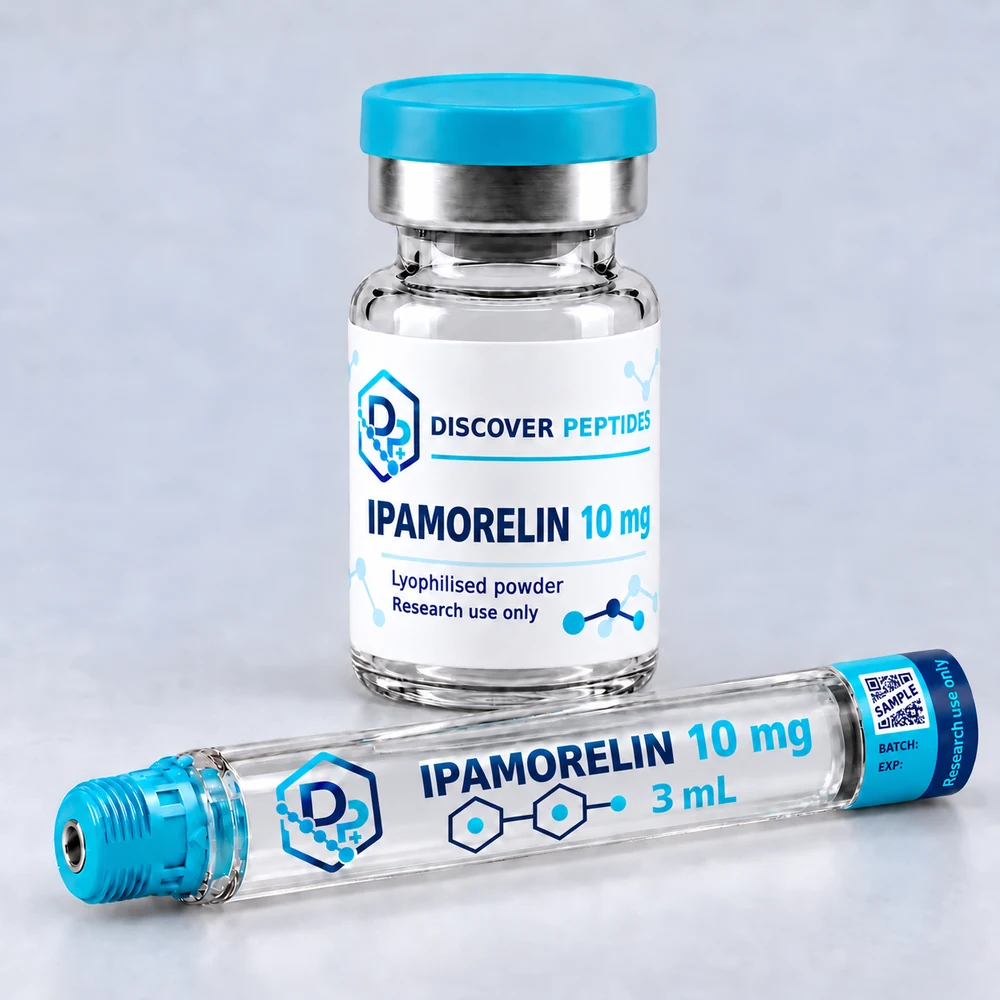
A vial labelled ‘tesamorelin’, ‘GHRH’, ‘GRF 1-44’, ‘research grade’ or with a CAS number is not thereby equivalent to an authorised finished medicine. Exact sequence, N-terminal modification, acetate content, peptide content, purity, sterility, formulation, stability and cold-chain history may be unknown.
Tesamorelin is not approved as a general obesity medicine, bodybuilding aid, anti-ageing therapy or substitute for growth hormone. Severe allergic symptoms, collapse, major swelling, visual or neurological symptoms, or symptoms of marked high blood glucose require urgent medical assessment.
What is tesamorelin acetate?
Tesamorelin is a synthetic analogue of the full 44-amino-acid human growth hormone-releasing factor sequence. A trans-3-hexenoyl group at the N-terminus makes it more resistant to enzymatic breakdown than native GHRH. The acetate description refers to the salt form used in the drug substance; it does not make unrelated GHRH fragments interchangeable.
Identity distinctions that prevent confusion
What is tesamorelin approved or researched for?
The current US prescribing information authorises EGRIFTA SV for reduction of excess abdominal fat in HIV-infected adults with lipodystrophy. The label expressly states that it is not indicated for weight-loss management and has a weight-neutral effect. The treatment target is abnormal visceral abdominal fat in a defined HIV population—not ordinary overweight or cosmetic spot reduction.
Excess visceral abdominal fat associated with HIV lipodystrophy in adults
Changes in waist circumference and visceral adipose tissue measured in clinical trials
Metabolic and quality-of-life questions related to HIV-associated fat redistribution
Its long-term cardiovascular safety has not been established. A reduction in a CT-measured fat compartment should not be presented as proof of fewer heart attacks, longer life, improved HIV control or durable benefit after treatment stops.
Other potential uses—only if future research confirms them
Randomised research in people living with HIV and hepatic steatosis found reductions in liver fat and less fibrosis progression over 12 months. These results are scientifically important, but tesamorelin is not thereby established as a general treatment for MASLD, MASH or liver fibrosis, either in people with or without HIV.
Other proposed uses—general obesity, age-related body-composition change, cognitive or immune effects, and performance enhancement—lack an authorised indication and require robust benefit-risk evidence. Biological plausibility or a change in GH/IGF-1 does not establish meaningful clinical benefit.
How does tesamorelin work?
Pituitary GH release
Tesamorelin binds pituitary GHRH receptors and stimulates endogenous, pulsatile growth hormone secretion. Growth hormone then promotes production of insulin-like growth factor 1 (IGF-1), principally in the liver, and influences fat metabolism and tissue growth.
Why visceral fat may fall
The GH–IGF-1 axis increases lipolytic signalling. In the studied HIV-lipodystrophy population, visceral adipose tissue fell more than subcutaneous abdominal fat. This compartment-specific effect explains why scale weight may change little even when CT-measured visceral fat decreases.
Why effects require monitoring
The same endocrine pathway can raise IGF-1, promote fluid retention and worsen glucose tolerance. Response and risk cannot be judged safely from appearance, waist measurement or a single hormone result alone.
What has evidence found?
Pivotal phase 3 trials
Two multicentre, randomised, double-blind, placebo-controlled phase 3 trials enrolled adults with HIV and excess abdominal fat. A pooled analysis found clinically meaningful reductions in visceral adipose tissue and waist circumference over 26 weeks, with little change in body weight. Fat tended to return after treatment withdrawal, indicating that the effect is not necessarily permanent.
Liver-fat randomised trial
A 12-month randomised trial in people with HIV and non-alcoholic fatty liver disease reported a greater reduction in hepatic fat fraction with tesamorelin than placebo and fewer participants with fibrosis progression. The sample and population were specific, and the study does not establish routine treatment for all fatty-liver disease.
Evidence boundaries
Trials used regulated product, protocol-defined eligibility, imaging and laboratory monitoring. Their results cannot be transferred to an unverified powder, a different GHRH analogue, a non-HIV weight-loss population or an improvised regimen.
Evidence and regulatory position in 2026
Current South African context
A review of publicly accessible SAHPRA materials did not identify a South African tesamorelin professional-information record on which to base a claim of local registration. This is not proof that no application, exceptional-access route or later registration exists. Current status should be checked directly in SAHPRA’s registered-health-products resources and through a South African pharmacist or authorised supplier.
US approval does not automatically confer South African registration, lawful advertising status, supply authorisation or reimbursement. A product offered online in South Africa as “research use only” should not be represented as the FDA-authorised finished medicine or as suitable for human self-administration.
How tesamorelin compares with related peptides
Known risks, contraindications and uncertainties
Commonly reported adverse effects include injection-site reactions, joint or limb pain, muscle pain, peripheral swelling and hypersensitivity reactions. Stimulation of the GH–IGF-1 axis can produce fluid retention, carpal-tunnel-type symptoms and clinically significant IGF-1 elevation.
Active malignancy is a contraindication; prior malignancy requires careful assessment because GH and IGF-1 are growth factors.
Hypothalamic-pituitary disruption—for example from surgery, tumour, irradiation, trauma or hypopituitarism—is contraindicated in the US label.
Pregnancy is contraindicated because reducing visceral fat offers no benefit and may pose fetal risk; treatment should stop if pregnancy occurs.
Glucose intolerance or diabetes can develop or worsen. Glucose status should be assessed before and during treatment.
Raised IGF-1 may persist and requires monitoring; the consequences of prolonged elevation are not fully known.
Hypersensitivity, including urticaria and angioedema, requires prompt discontinuation and medical assessment.
Treatment and measurement safeguards
This page deliberately does not give a personal dose, mixing instruction, syringe-unit conversion or protocol for bulk powder. EGRIFTA formulations are not necessarily interchangeable on a milligram-for-milligram or volume-for-volume basis; the applicable label and presentation govern preparation and administration.
Professional assessment may include HIV treatment history, waist and body-composition context, fasting glucose or HbA1c, IGF-1, malignancy history, pregnancy status and evaluation of pituitary disease. Imaging-derived visceral or hepatic fat outcomes are not replicated by a bathroom scale.
Common questions
Is tesamorelin a weight-loss peptide?
No. Its US indication is reduction of excess abdominal fat in adults with HIV-associated lipodystrophy, and the label says it is not indicated for weight-loss management.
Is it human growth hormone?
No. It stimulates the pituitary to release endogenous GH; somatropin is recombinant GH itself.
Is it the same as sermorelin or CJC-1295?
No. They differ in sequence, chemical modification, duration, evidence and regulatory status.
Can it treat fatty liver?
A specific HIV-associated trial is encouraging, but routine MASLD/MASH treatment remains investigational.
Will visceral fat stay off after stopping?
Not necessarily. Trial follow-up showed reaccumulation after withdrawal.
Does a CAS number prove authenticity?
No. It does not establish sequence confirmation, peptide content, sterility, formulation, stability or authorised medicine status.
Is it registered in South Africa?
No public SAHPRA product record was identified in this review; verify the current position directly because databases and authorisations can change.
Join for research and regulatory updates
Join the future research bulletin for major trial results, product-information revisions, safety communications and South African status changes. Subscription does not provide medical advice, prescribing, product supply or injection instructions.
Consent wording for the future form: “I agree to receive evidence and regulatory updates by email. This service does not provide medical advice, personal dosing instructions or product supply.”
Sources and further reading
US Food and Drug Administration. EGRIFTA SV (tesamorelin for injection) prescribing information, revised November 2024. Application 022505/S-018.
Falutz J, et al. Effects of tesamorelin in HIV-infected patients with excess abdominal fat: pooled analysis of two phase 3 trials with safety extension data. Journal of Clinical Endocrinology & Metabolism. 2010;95:4291-4304. PMID 20554713.
Stanley TL, et al. Effect of tesamorelin on visceral fat and liver fat in HIV-infected patients with abdominal fat accumulation: a randomized clinical trial. JAMA. 2014;312:380-389. PMID 25038357.
Stanley TL, et al. Effects of tesamorelin on non-alcoholic fatty liver disease in HIV: a randomised, double-blind, multicentre trial. Lancet HIV. 2019;6:e821-e830. PMID 31611038.
ClinicalTrials.gov. NCT02196831: Tesamorelin Effects on Liver Fat and Histology in HIV.
SAHPRA. Registered health products and professional-information resources; searched 7 September 2026.
Editorial method: current regulator documents and peer-reviewed randomised evidence were prioritised over commercial pages. Product status is jurisdiction- and brand-specific. Review after major safety or registration changes, and no later than March 2027.


Reviews
There are no reviews yet.